DIGNITY OF CHILDREN · DR. TOLEDO
The Weekly Practice
Issue No. 02 Week of June 29, 2026 Theme: Belonging and Repair
A Message to the Program Leader
This week I am writing to you, the leader who carries this work on the ground. The purpose of this practice does not change from one issue to the next. It exists to support your mindset and to put usable tools and strategies in your hands, so that the outcomes you want to see in your program grow out of the way you lead it. I want to say plainly what is easy to lose sight of in a full season. The results you are hoping for depend on your full attention to two things held in balance: the energy of your culture and the systems beneath it that need adjustment to meet the needs of your staff, your children, and your families. A program does not become a place where people belong because one person wills it into being. It becomes that place because the leader keeps reading the room and keeps adjusting the systems that decide who feels included and who feels on the outside.
This issue is about belonging and repair. Belonging is not a feeling you announce; it is a condition you build, and repair is the system that protects it when something goes wrong. The costliest mistake a tired leader makes is to treat conflict, withdrawal, or a hard moment as the end of someone standing in the community. When a staff member or a child believes that one bad day removes their place, they stop contributing their strengths and ideas, and the moment they go quiet, you lose access to your own strengths as well, because a leader who insists on being the only steady source eventually runs dry. A program built on belonging and repair invites people back in, and the room begins to give back more than you could have produced alone. Every section below is offered to help you build that.
With dignity and purpose,
Dr. Toledo
Sonia Toledo, PhD · Founder, Dignity of Children · Author, Beyond Supervision
BOOK LAUNCH · JUNE 30, 2026
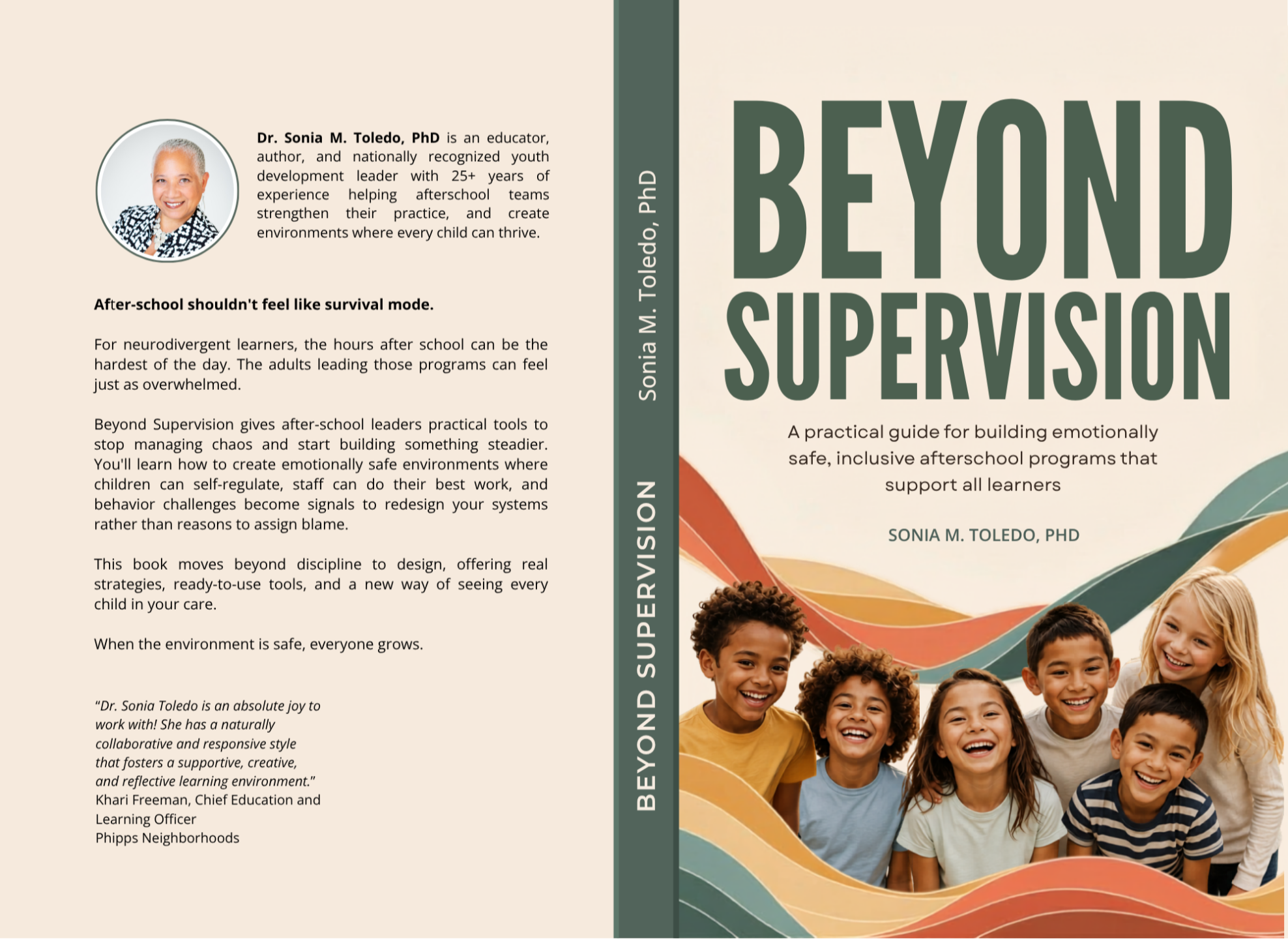
Beyond Supervision
My book, Beyond Supervision, is a practical guide for after-school leaders who want emotionally safe, inclusive programs that work for neurodivergent children. And since we are all neurodivergent in our own way, it is really a guide for everyone. The framework, the stories, and the tools sit in one place, so a steady program no longer depends on who happens to be in the room that day.
Get your copy: BEYOND SUPERVSION
SECTION 1 · THE FRAMEWORK
From Belief to Outcomes
This week's single concept: Working Memory
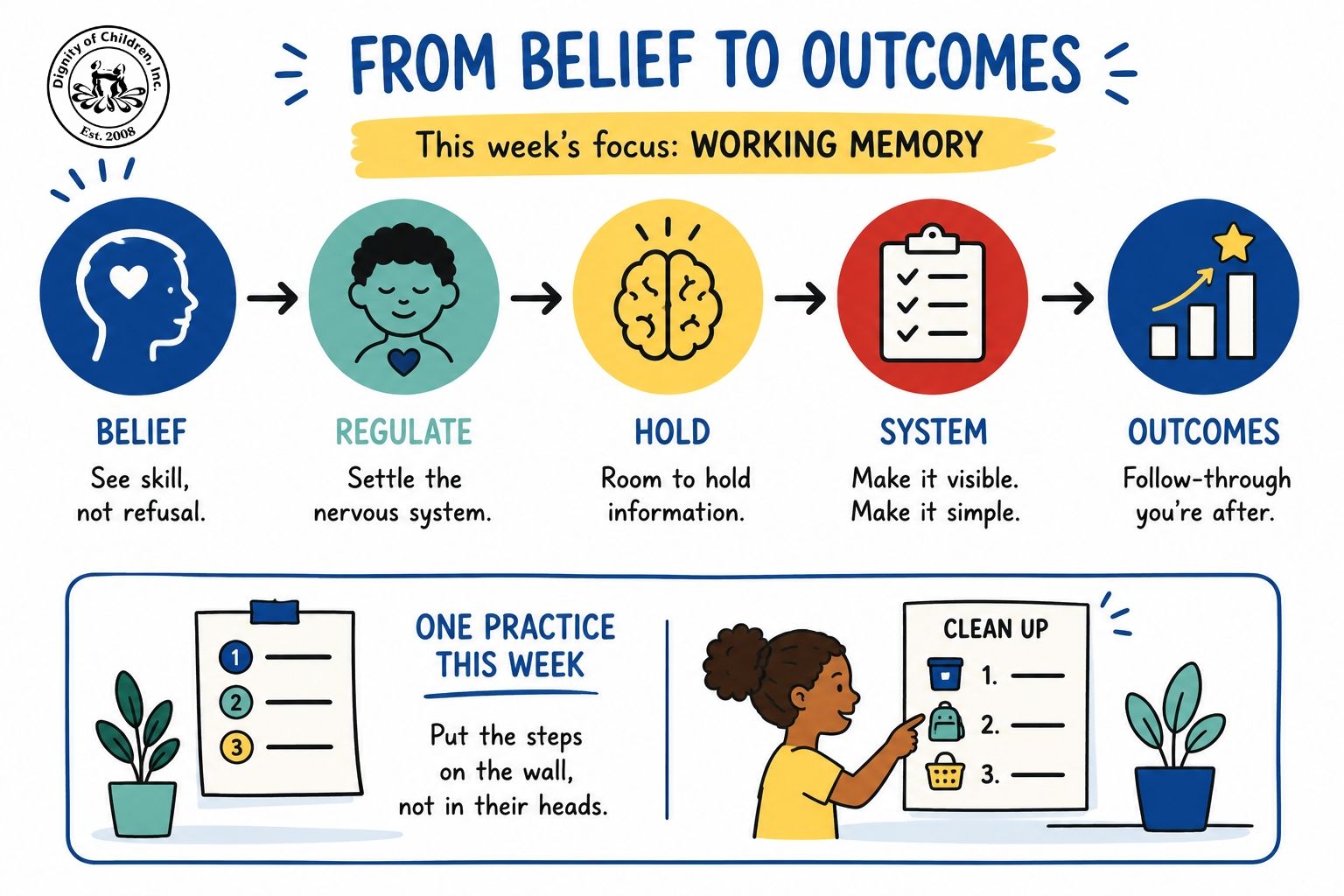
The From Belief to Outcomes framework starts with one link: what you believe and what your nervous system does shape what you see and how you respond. The chain runs in order. First, we believe a child is missing a skill, not refusing to listen. That belief lets us settle the nervous system first. A settled nervous system has room to hold information. Information held inside a steady, predictable system becomes the follow-through you were after. We take one link at a time, so it holds.
THIS WEEK’S FOCUS
Working memory is not about how much a child can remember. It is about how little we make them hold alone.
Working memory is the brain's sticky note: the small, fragile space where a child holds a direction long enough to act on it. It is also the first thing to vanish when a child is tired, anxious, or overstimulated. So, we do not build it by asking children to remember harder. We build it by shrinking what they have to hold, and by putting the rest somewhere they can see.
ONE PRACTICE TO APPLY THIS WEEK
Put the steps on the wall, not in their heads.
A direction like “clean up and get ready for snack” is not one instruction. It is four or five, and a child has to hold all of them while also doing the first one. That is where tasks stall, not because a child will not start, but because the sequence fell off the sticky note halfway through. The toolkit Task Breakdown Cards fix this by turning a big instruction into three to five visible steps, posted where the child can glance back. Now the wall holds the sequence, and the child only must do the next step. You stop repeating yourself, and they stop guessing where they left off.
TIP THIS WEEK
Build one task breakdown card with the group, while everyone is calm.
Pick a routine that stalls every day, cleanup, transitions, packing up, and build the card together before you ever need it. Make it the same every time.
- Name the task. Choose one routine that breaks down daily and say it plainly: “Let's build the steps for cleanup, so nobody has to remember them.”
- Break it down. Say the routine out loud and break it into three to five small steps with the group. Keep each step in one action.
- Make it visible. Write or draw each step on a card, in order, and post it at child height where the routine happens. A picture beside each word lets pre-readers use it too.
- Walk together. Point to each step as the group does it once, while everyone is calm. You are teaching the card, not just hanging it.
- Point-don't repeat. From now on, when a child stalls, point to the card rather than restate the steps. The wall does the remembering, so you do not have to.
Run it the same way every day this week. Same card, same order. By Friday, the steps live on the wall and in their hands, not on your voice.
SECTION 2 · THE BENEFIT
Systems That Support Staff
Developing Your Staff and Protecting Their Well-Being
Staff well-being is not a reward you hand out when there is time left over. It is part of the system that produces outcomes. A staff member who feels unseen, unsupported, or braced for the next correction cannot foster a sense of belonging for a child, because no one can offer a sense of welcome they do not feel themselves. So, the systems that develop your staff and the systems that protect their well-being are the same systems, and when you build them on purpose, you stop relying on the heroic effort of whoever happens to be in the room that day.
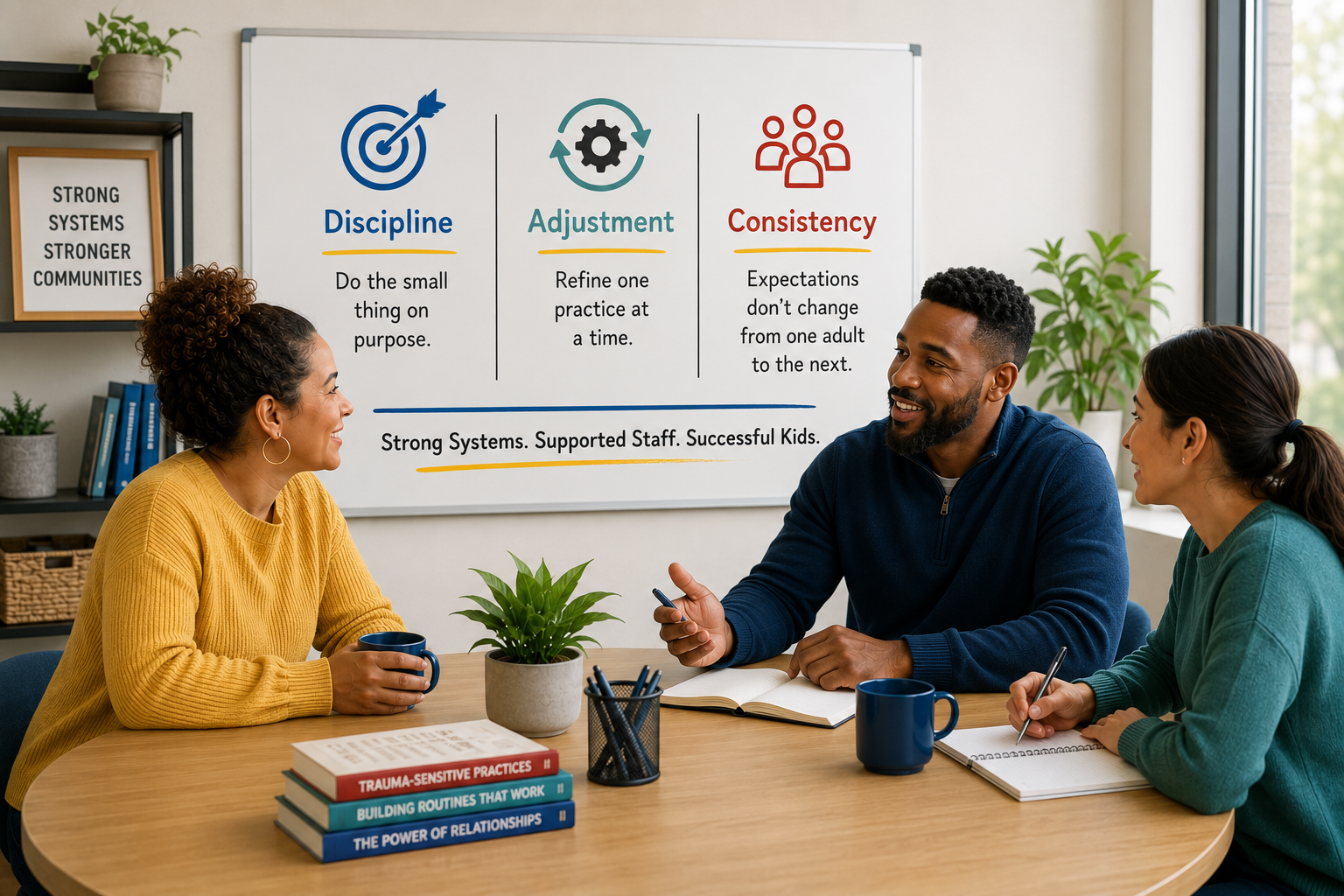
Build emotionally safe spaces for adults the same way you would for children, through predictable structure. An emotionally safe team has regular check-ins focused on support rather than surveillance, consistent expectations from one supervisor to the next, protected time to plan and breathe, and a culture where naming a struggle is treated as professionalism rather than weakness. Give your team a shared language for the energy of the room and use it with them the way you use it with children, so an adult can say where they are without being singled out. A staff member who is invited to shape the work, and who knows that a hard day will not erase their standing, is a staff member who stays.
Remember that your own nervous system sets the tone for everyone else. You are the thermostat in the room, not the thermometer. Your staff read your steadiness or your strain long before they hear your words, and they regulate it. This is both a responsibility and a relief. One of the most powerful things you can do for staff development this week is to look after your own regulation and to build a system that refills your cup instead of asking you to lead on empty.
One small step this week: choose one moment of repair you have been avoiding with a staff member and reopen it on purpose. A short, direct conversation that separates the person from the problem tells your whole team that standing in this community is not lost over a single hard day.

SECTION 3
An Emotionally Safe Environment for Everyone
Building Safety, and Knowing When to Adjust
An emotionally safe environment is one where every person, staff and child alike, can take a risk, make a mistake, reset, and rejoin without losing their place in the community. That last part is the heart of belonging. Safety is built through warmth and structure held together, predictable routines, boundaries delivered with dignity, and adults who stay steady when feelings get big. But safety is not something you establish once and check off. This work has to be continuously observed, with honesty and with a real commitment to apply new tools when the ones you have are no longer serving the community. Honesty matters most because it is tempting to decide the system is fine just because it was fine last month. The leaders who build the safest rooms are the ones willing to keep looking.
How do you know that systems need adjustments? (read more)
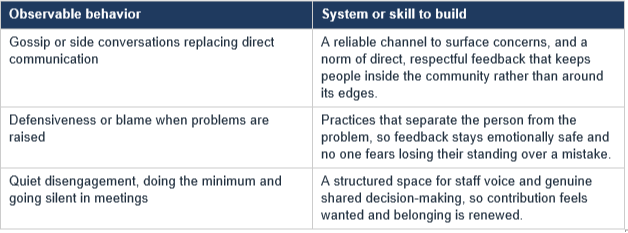
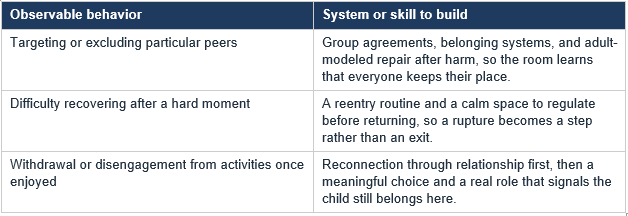
You know by watching behavior, because behavior is data rather than a verdict. When a system meets people's needs, you see engagement, recovery, and contribution. When a system is failing, you see dysfunction, and it shows up in both staff and children. Behavior is not the problem of being punished. They are the signal telling you which system to build or adjust. Use the tables below to read the signal. Each observable behavior is paired with the system or skill to build.
In staff, watch for these signals this week:
In children, watch for these signals this week:
One small step this week: pick one recurring dysfunction you have been observing as a person's problem, name the system underneath it, and change one thing about that system. Then observe what happens over the week.
SECTION 4 · BUILD EXECUTIVE FUNCTIONS
This Week’s Focus Skill & Tool
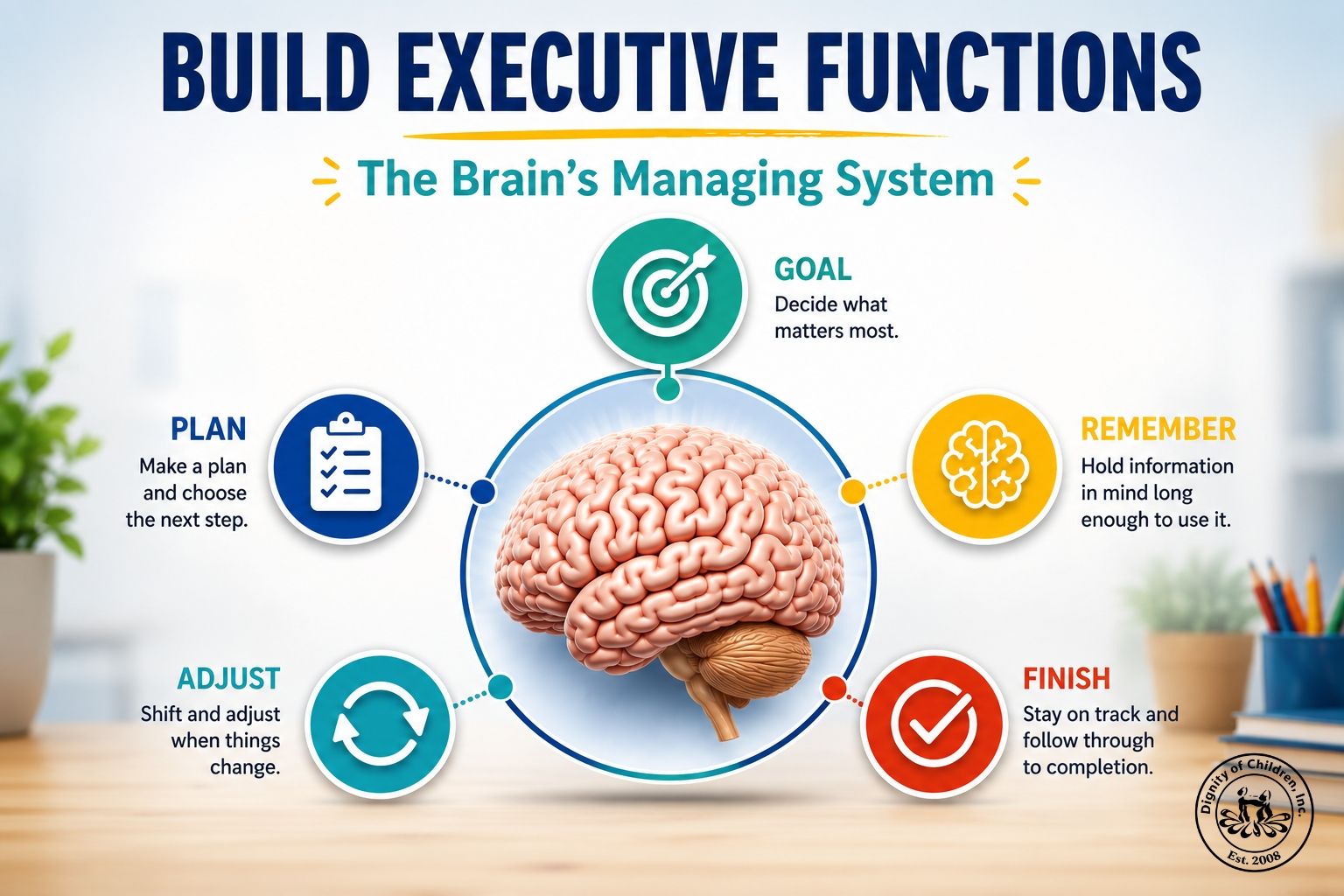
The executive function is the brain’s managing system. It is the set of skills that help a person decide what to do, when to do it, and how to adjust along the way. It is not about character, respect, or motivation, and it is not a trait you are born with or without. Like any skill, it grows through small rs, repeated. We take one skill at a time, then put a real tool in our hands.
Focus Skill: Working Memory
Working memory is the brain's holding space: the ability to keep information in mind long enough to use it, like remembering step two while doing step one, or holding a question until it is your turn to ask. While it is still growing, it can look like forgetting multi-step directions, losing track halfway through a task, asking “what are we doing?” right after you said it, or starting strong and drifting off. That is not refusing to listen. The information slipped off the sticky note before they could use it. It does not grow through louder reminders. It grows through fewer things to hold at once, visible cues the room provides, predictable routines, and a calm adult close by whose steadiness helps a child's body settle enough to hold on to the plan.
The Tool: Executive Function Skills Checklist (read more)
A staff-friendly checklist that names what is happening without naming the child as the problem. This week, before you correct a child for not listening, scan the working-memory prompts and ask which support is missing. Can the child:
☐ Follow multi-step directions without needing reminders
☐ Remember the instructions given earlier in the day
☐ Hold information in mind while doing another task (like remembering what to get on the way across the room)
☐ Retell a story or sequence events in order
TRY THIS WEEK
Run one memory-stretch game from the toolkit.
Working memory grows when kids have to hold something in mind and then do something with it, and a game makes the holding feel like play instead of a test. Two systems from the toolkit do this well. In Teach Back Through Symbols, small groups read a short section, then draw one symbol that captures it for the rest of the room, holding the meaning in mind and turning it into something they can show. In the 1-3-6 Process, each child reads, then carries three main takeaways and a few key words into a group of three, and then a group of six, retelling them each time. Different games, same skill underneath: hold it, keep it, use it.

SECTION 5 · What Staff Are Saying About Our Training
What Staff Said About From Distraction to Action
Our workshop, From Distraction to Action, in the words of the staff who took it.
From Distraction to Action: Boosting Students’ Executive Function Skills is for staff who run rooms where kids struggle to focus, get organized, and follow directions. We start with the skills underneath the behavior: working memory, planning, and self-regulation, and how emotional growth makes all three possible. Staff walk out with practical moves to build a supportive, inclusive room that works for neurodivergent learners and for anyone whose executive function is still catching up.
“This training taught me to better understand kids while also controlling my own emotions so I can better support them.”
Sarah, NYJTL
“The information was informative as well as influential. What I learned will be implemented in the future”
Darrell, NYJTL
Click HERE to see a list of our Workshops
SECTION 6 · PARTNER HIGHLIGHT
We Cannot Do This Work Alone
None of us builds a strong program in isolation. The leaders who go the furthest are the ones who surround themselves with partners, resources, and people who strengthen the work. Each week I will introduce a new partner you can add to your own resources, so that over time you build a network you can lean on instead of carrying everything yourself.
This week's partner is Dynamic Management Services
Close Your Compliance Gap
Save money and secure your organization against today’s AI and cyber threats.
As AI transforms the way organizations conduct everyday business, organizations are facing enterprise-level expectations on two fronts at once: proving cybersecurity readiness and adopting AI responsibly. Enterprise-level tools are a burdensome cost to organizations already facing budget constraints and a lack of dedicated staff. With the ongoing threat landscape on both fronts, we work with you to protect your businesses using proven strategies and tools to meet your AI and cybersecurity needs.
Dynamic Management Services closes that gap with customized tools and consulting services to help you manage these risks.
Our self-directed tools are grounded in two federal standards, the NIST Cybersecurity Framework 2.0 and the NIST AI Risk Management Framework, and deliver board-ready, audit-ready documentation at a fraction of traditional consulting costs. With our tools, your organization will meet requirements for federal or state contracts and for cyber-insurance, saving you time and money.
Our cybersecurity and AI governance awareness trainings allow organizations to pair workforce training and written policies into a comprehensive, enforceable layer of protection to support your AI transformation journey.
1 - Assess Your Risk
2 - Build Your Policies
3 - Train Your Team
4 - Book a Consultation
www.strategydms.com | 862-352-3931 | [email protected]
SECTION 7 · Trends in the Field
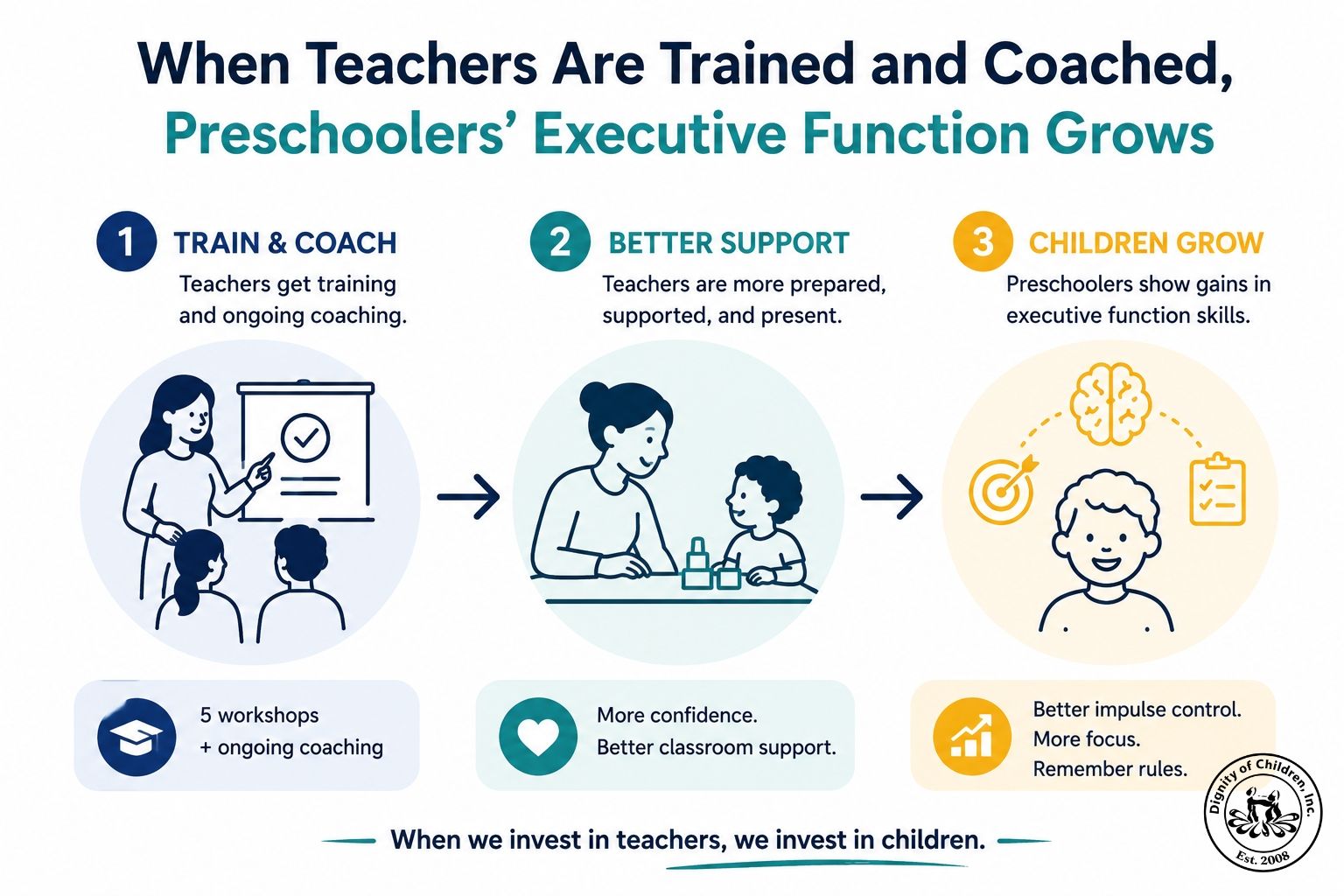
When Teachers Are Trained and Coached, Preschoolers' Executive Function Grows
University of Rhode Island · June 10, 2026 · published in Early Childhood Research Quarterly
A new study from the University of Rhode Island and Michigan State University, conducted with the early-education nonprofit HighScope and funded by a U.S. Department of Education grant, asked a question most training skips: does investing in the adults actually move children's executive function, the skills they use to control impulses, pay attention, and remember the rules of the room? Researchers followed 317 preschoolers. Their teachers were split into two groups, one that attended five professional-learning workshops plus ongoing coaching from experienced early-childhood educators, and one that taught the same curriculum with no extra support.
From fall to spring, the children whose teachers received the training and coaching showed measurable, if modest, gains in executive function over the children whose teachers did not. The researchers were careful: they noted that pandemic-era disruption and staff turnover likely held the gains back, and that shorter, more frequent training sessions might do even more. The signal still points one way. When the adult is better supported, the child's brain has more room to grow.
WHY IT MATTERS FOR OUR WORK
Children's executive function does not grow from being reminded more. It grows next to an adult who was given the time, training, and support to show up prepared.
That is our whole premise. The skills a child uses to hold a direction and follow through are built by the system around them, and the most important part of that system is a present, prepared, trusted adult. Investing in staff is not a step away from the children. It is one of the most direct things we can do for them.
Source: Ahmed, S., et al., Early Childhood Research Quarterly (2026); University of Rhode Island, “Study shows gains in preschoolers' executive function with additional teacher training” (June 10, 2026).

SECTION 8 · HIGHLIGHTS
Missed the live broadcast or want to watch it again?
Moments from the spotlight, our partners, and recent events.
You can now watch the full Day 12 session of the Rediscover Your Purpose speaker interview series! Tune in to hear Irene O'Brien host an insightful conversation with Dr. Sonia Toledo. Learn the 21 tools designed to unlock your clarity, conquer negative self-talk, and reignite your spark for your next meaningful chapter.
A Question to Carry into the Week
Where in your program does a hard moment currently cost someone their place in the community, and what is the one system of repair you could build this week so that belonging survives the rupture?
With dignity and purpose,
Dr. Toledo
Sonia Toledo, PhD · Founder, Dignity of Children · Author, Beyond Supervision
Join the Safe to Thrive movement HERE
Get your Copy Beyond Supervision
Enroll to Lead with Heart & Mind: 6-Week Guided Transformational Journey HERE
Book Professional Development Workshops for Educators HERE
Book Professional Development Workshops for Leadership HERE
Register for Director's Lab 2.0 - a program for Supervisors and Directors
To discuss your training needs, schedule a one-on-one consultation with me HERE
Dignity of Children
The Weekly Practice · Building quality through discipline, adjustment, and consistency.