DIGNITY OF CHILDREN · DR. TOLEDO
The Weekly Practice
Issue No. 09 Week of August 18th, 2026 Focus: Belief
A Message to the Program Leader
I want to begin by acknowledging you directly, because the work you do is rarely named for what it is. You lead a program that asks you to hold coverage, safety, compliance, and the quality of every afternoon at the same time, and carrying all of it well is difficult. That difficulty is not a sign that you are falling short. It is the honest weight of the role, and it deserves to be recognized before anything else is asked of you.
Running an effective program is, at its center, the work of sustaining relationships, the ones you hold with your staff, the ones your staff hold with your children, and the ones your program holds with the families who trust you. Keeping all of them healthy at once, under real limits of time and people, asks more of you than any single item on your task list, and it is the true labor of leadership rather than a distraction from it.
This is why your own self-care and self-management are not separate from the program but part of its foundation. Managing your own state is a form of emotional intelligence. The adults are what makes emotional growth possible in the children they serve. A leader who tends her own awareness and regulation keeps the one instrument the whole program depends on in working order. This week's teaching turns to the first link of the From Belief to Outcomes framework, belief, and to the story you carry into a hard moment before anyone has acted.
Your emotional intelligence focus this week: self-awareness. This week, notice which child or which staff member you brace for before anything has actually happened, and ask what belief that bracing reveals. You are not judging the feeling or forcing it away. You are catching the story your mind wrote in advance, because a belief you can see is one you can question, and a belief you cannot see runs the room without you.
Next week we move to the second link of the From Belief to Outcomes framework, the nervous system, and to what you do in those first seconds inside your own body, before you address anyone else's.
With dignity and purpose,
Dr. Toledo
Sonia Toledo, PhD, Founder and CEO, Dignity of Children, Author, Beyond Supervision

THIS WEEK'S FOCUS:
BELIEF
Return to that half second on Monday morning. The child braced for a fight is not yet the problem you are solving, because before you have said a word, your mind has already assigned him a category, and that category quietly sets the terms for everything that follows. If the belief is that he arrived looking for trouble, you begin managing a threat. If the belief is that he arrived expecting rejection and is testing whether it will come, you begin offering him a different experience. The child and the morning are the same in both cases. What differs is the belief you carried in, and the program that grows from it.
How much a single belief carries is not a matter of intuition, because researchers have isolated it. In one study, two different teachers were each asked to predict how far the same student would go in school, which let the researchers compare expectations for one child while holding the child constant. The predictions diverged in patterned ways, and the gap mattered, because a teacher's expectation was not a neutral guess about the future; it was a force that helped bring the future about (Gershenson, Holt, & Papageorge, 2016). The same student walked into two sets of beliefs, and those beliefs began pulling toward two different outcomes.
A second study followed the belief across years rather than a single prediction. Researchers tracked roughly eleven thousand students entering secondary school and measured the gap between what teachers expected of each student and what the student's own prior achievement and ability would have predicted, then watched those students for five years. Where a teacher's expectation ran higher or lower than the evidence warranted, that bias did not wash out; it shaped the student's performance and persisted across the years that followed (de Boer, Bosker, & van der Werf, 2010). A belief formed early, and often without notice, kept working long after the moment that produced it had passed.
For you as the leader, the lesson is not to feel guilty that your mind produces these beliefs, because every mind produces them quickly and beneath awareness. The lesson is that a belief you have noticed is a belief you can weigh, while one you never notice simply runs. Your first task, then, is not to correct your staff's beliefs about the children, or even to correct your own in the moment. It is to see them at all, to catch the read you have already made before it hardens into the way a child is treated for the rest of the session, because everything the next four links build- the regulation, the skills, the systems, and the outcomes, is poured on top of the belief you started with.
Source and reading: Gershenson, S., Holt, S. B., & Papageorge, N. W. (2016). Who believes in me? The effect of student-teacher demographic match on teacher expectations. Economics of Education Review, 52, 209-224. de Boer, H., Bosker, R. J., & van der Werf, M. P. C. (2010). Sustainability of teacher expectation bias effects on long-term student performance. Journal of Educational Psychology, 102(1), 168-179.

A REFRAME TOOL FOR THE WEEK
A belief is easiest to question when you set it beside an alternative and choose which one to act on. Below are three reads you may recognize from your own program. The point is not that the second column is always the kinder truth; it is that a second reading exists at all, and that naming it returns the choice to you. This week, when you catch the first column running, hold the second one up beside it before you respond.
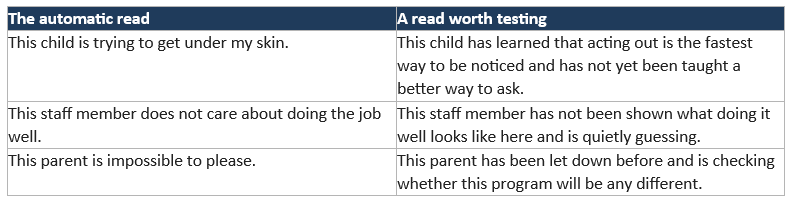
None of these second readings excuses a behavior or lowers a standard. Each one simply changes what you build next, because a child who is testing for rejection, a staff member who is guessing, and a parent who is bracing for disappointment each call for a different response than the automatic read would have produced.

One Small Step this Week
This week, gather the staff who work most closely with one or two children who have been wearing on the team, and spend ten minutes surfacing the beliefs the group already holds about them, said plainly and without blame. Then, together, name one alternative read for each child that the evidence would also support and agree to treat the child as if that second reading were true for a week. Moving a belief at the level of the whole team, rather than privately inside your own head, is a program decision, because the children meet every adult's expectation, not only yours.

What Staff Are Saying About From Our Training
Our Professional Development workshops in the words of the staff who took it.
Dignity of Children leads professional development workshops for afterschool and youth program staff, built on the same practices this newsletter works through, from the From Belief to Outcomes framework to the daily work of regulation, relationship, and program culture. To bring a workshop to your team, book a conversation at dignityofchildren.com/afterschool-staff-workshops.
"This was a great reflection for myself as a leader in my program. I am leaving feeling inspired and with a goal!"
- Rosalyn, El Sistema Somerville
"Sonia was highly knowledgeable and a really warm presence - she got us all to engage more with eachother which I loved"
- Bridget, Mystic Learning Center

PARTNER HIGHLIGHT
We Cannot Do This Work Alone
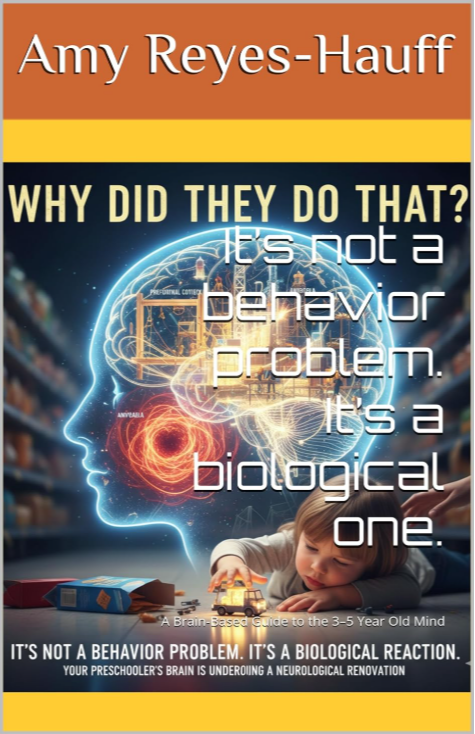
Empowering Early Childhood Communities with Saddle Up Strategy Solutions LLC & Dignity of Children
How We Are Connecting Innovative Early Childhood Practices, Play-Based Learning, and Strategic Leadership to Create More Supportive Environments for Children, Educators, and Families.
At Dignity of Children, we value partnerships with organizations that share our commitment to strengthening early childhood education and supporting the well-being of children, educators, and families. This month, we are pleased to highlight Saddle Up Strategy Solutions LLC, a valued partner whose expertise and mission align with our vision for creating meaningful, positive change in the early childhood field.
In service of children-
O: 307-777-7708 C: 307-331-7035
TRENDS IN YOUTH DEVELOPMENT
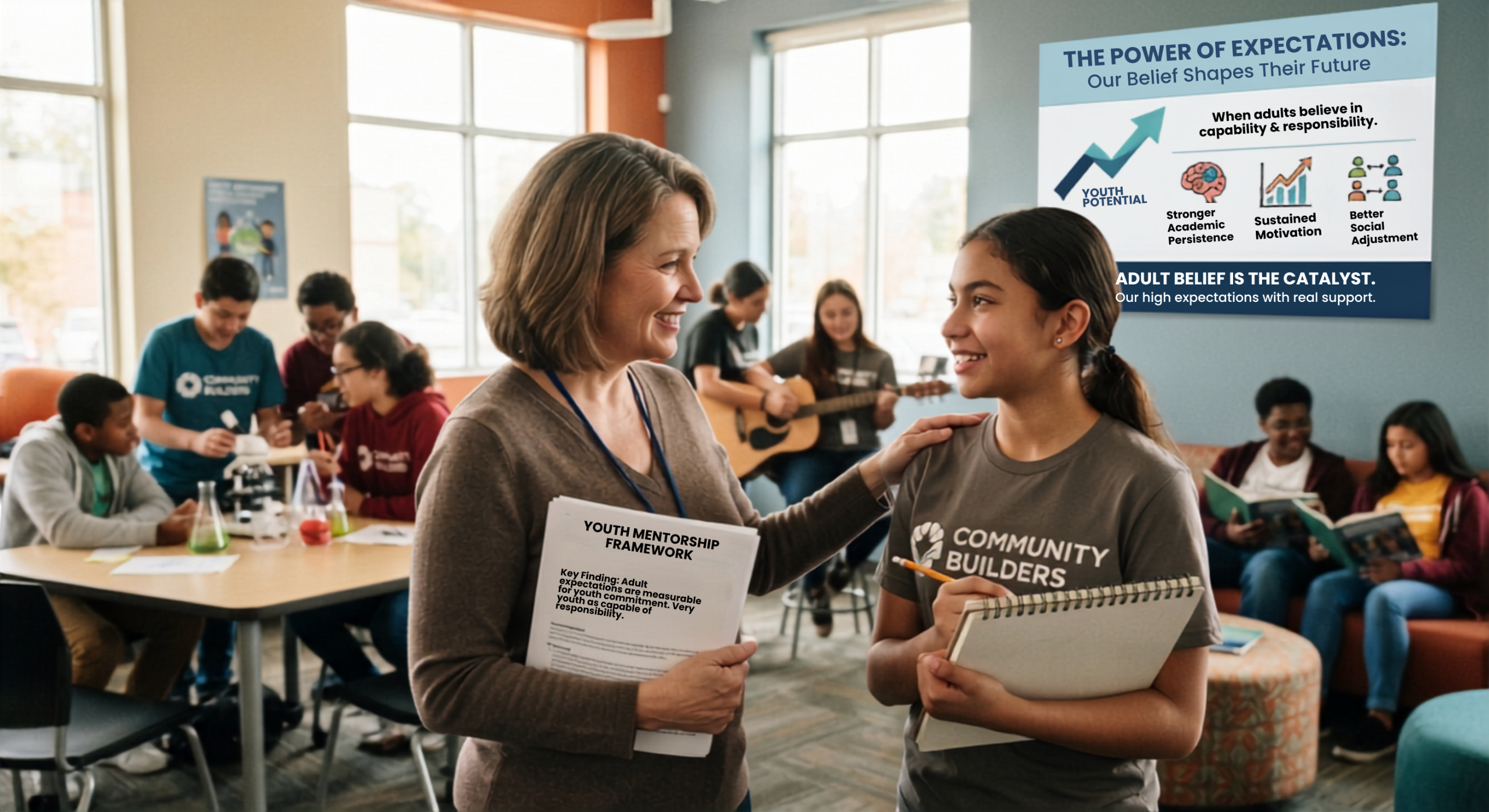
One idea gaining real traction in youth development right now is that the expectations adults hold are not a soft background factor but a measurable driver of how young people turn out, which places the adult's own belief at the center of practice. A study published this year in the journal Child Development, and summarized for practitioners by the mentoring researcher Jean Rhodes, followed more than eight hundred adolescents across two years and found that when the parents and teachers around them viewed them as capable of carrying real responsibility, rather than as burdens to be managed, those young people showed stronger academic persistence, sustained motivation, and better social adjustment over time, with the adults' early views predicting the later outcomes rather than the reverse (Rhodes, 2025). The finding sits squarely on this week's focus, because it shows that a belief held by the adults, formed before the young person has proven anything, quietly shapes what the young person becomes. For your program, it is a practical reminder that raising the expectations your staff carry for the children, and pairing those expectations with real support, is not wishful thinking; it is one of the better-evidenced moves available to you.
Source and reading: Rhodes, J. (2025). New study highlights the power of expecting more from teens. The Chronicle of Evidence-Based Mentoring. https://www.evidencebasedmentoring.org/when-mentors-expect-more-youth-rise-to-meet-them/
JOIN ME IN CELEBRATING MY MILESTONE
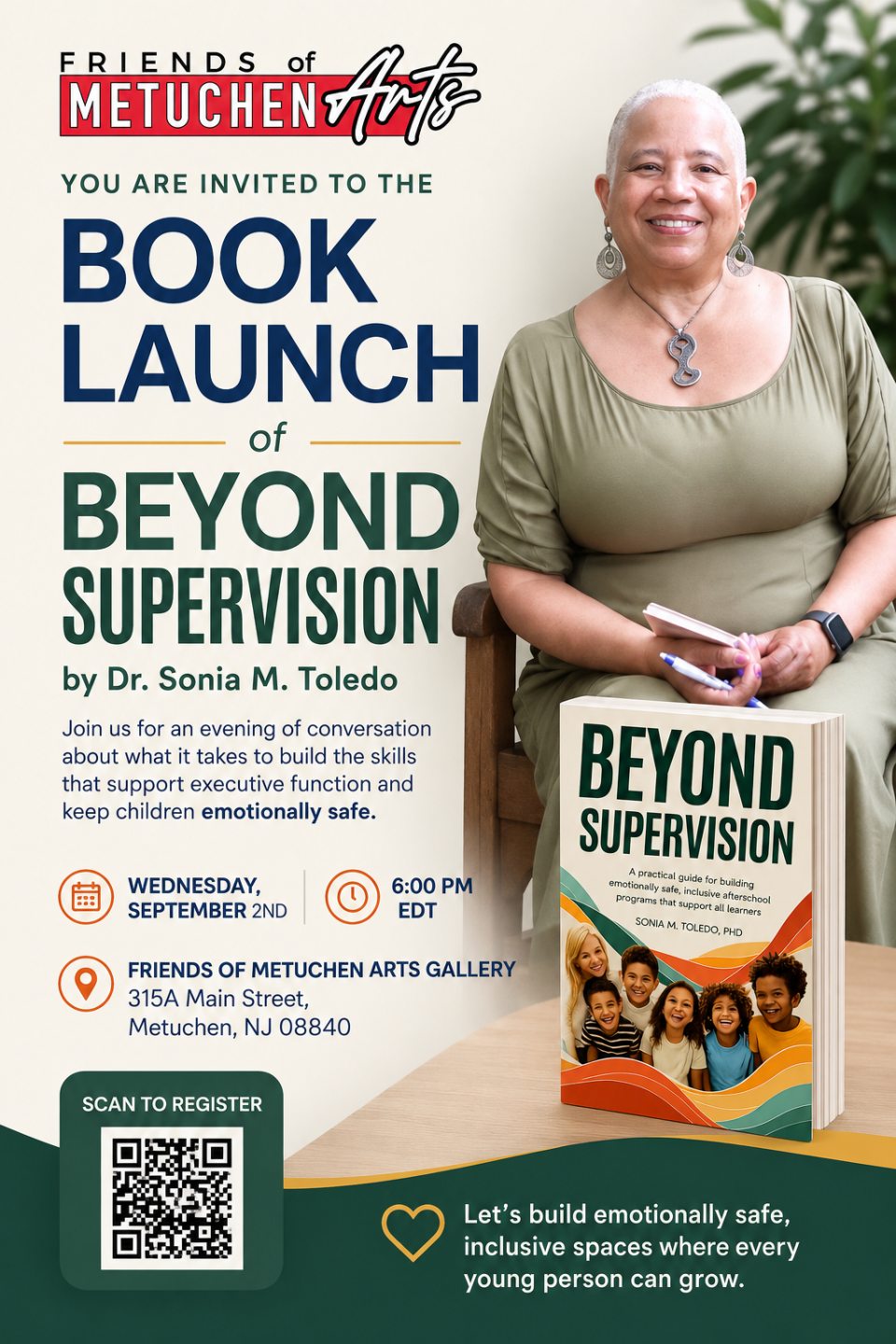
Beyond Supervision walks through all five links of the From Belief to Outcomes framework: Belief, Nervous System, Executive Function, Systems, and Outcomes. Buy the book here. If it has helped your practice, leave a review here.
A Question to Carry into the Week
Which child have I already decided about, before this week has offered me any new evidence?
With dignity and purpose,
Dr. Toledo
Sonia Toledo, PhD · Founder and CEO, Dignity of Children · Author, Beyond Supervision
P.S. If this issue named something real about your week, forward it to one colleague or leader who works the same repeating afternoons you do, and invite them to sign up for The Weekly Practice so it reaches them directly each week. (add the link to opt-in to the newsletter here)



Join the Safe to Thrive movement HERE
Get your Copy Beyond Supervision
Enroll to Lead with Heart & Mind: 6-Week Guided Transformational Journey HERE
Book Professional Development Workshops for Educators HERE
Book Professional Development Workshops for Leadership HERE
Register for Director's Lab 2.0 - a program for Supervisors and Directors
To discuss your training needs, schedule a one-on-one consultation with me HERE
Dignity of Children
The Weekly Practice · Building quality through discipline, adjustment, and consistency.