DIGNITY OF CHILDREN · DR. TOLEDO
The Weekly Practice
Issue No. 07 Week of August 3rd, 2026 Focus: Systems
A Message to the Program Leader
You lead a program that is held together by relationships: the ones you keep with your staff, the ones your staff keep with your children, and the ones your program keeps with the families who trust you with their afternoons. Managing all of them well, at the same time, under real limits of time and staffing, is the actual work of leadership, and it asks more of you than any single task on your list. I want to acknowledge plainly how much you carry, because it is easy to pour yourself into everyone else and leave nothing for the person doing the pouring.
This is why your own self-care and self-management are not separate from the program. They are part of its infrastructure. The adults in your building set the emotional tone the children take in, so a leader who manages her own state and refuses to run herself empty is not indulging herself; she is protecting the one instrument the whole program depends on. Emotional intelligence in the adults is what makes emotional growth possible in the children they serve. This week's teaching turns to the fourth link of the From Belief to Outcomes framework, systems, and to how the right routines protect both your staff and you from having to hold everything by hand.
Your emotional intelligence focus this week: self-management. Before you give the next hour away, decide one thing you will protect for yourself inside it: a brief pause, a boundary, a task you will not carry alone. Managing your own state is the first act of care in a program built on relationships, because children are served best by adults who still have something left to give.
With dignity and purpose,
Dr. Toledo
Sonia Toledo, PhD, Founder and CEO, Dignity of Children, Author, Beyond Supervision
Next week: how to read what your systems are actually producing, and feed that reading back so the next routine works better than the last. We move to the fifth link of the framework, outcomes.
THIS WEEK'S FOCUS:
Systems
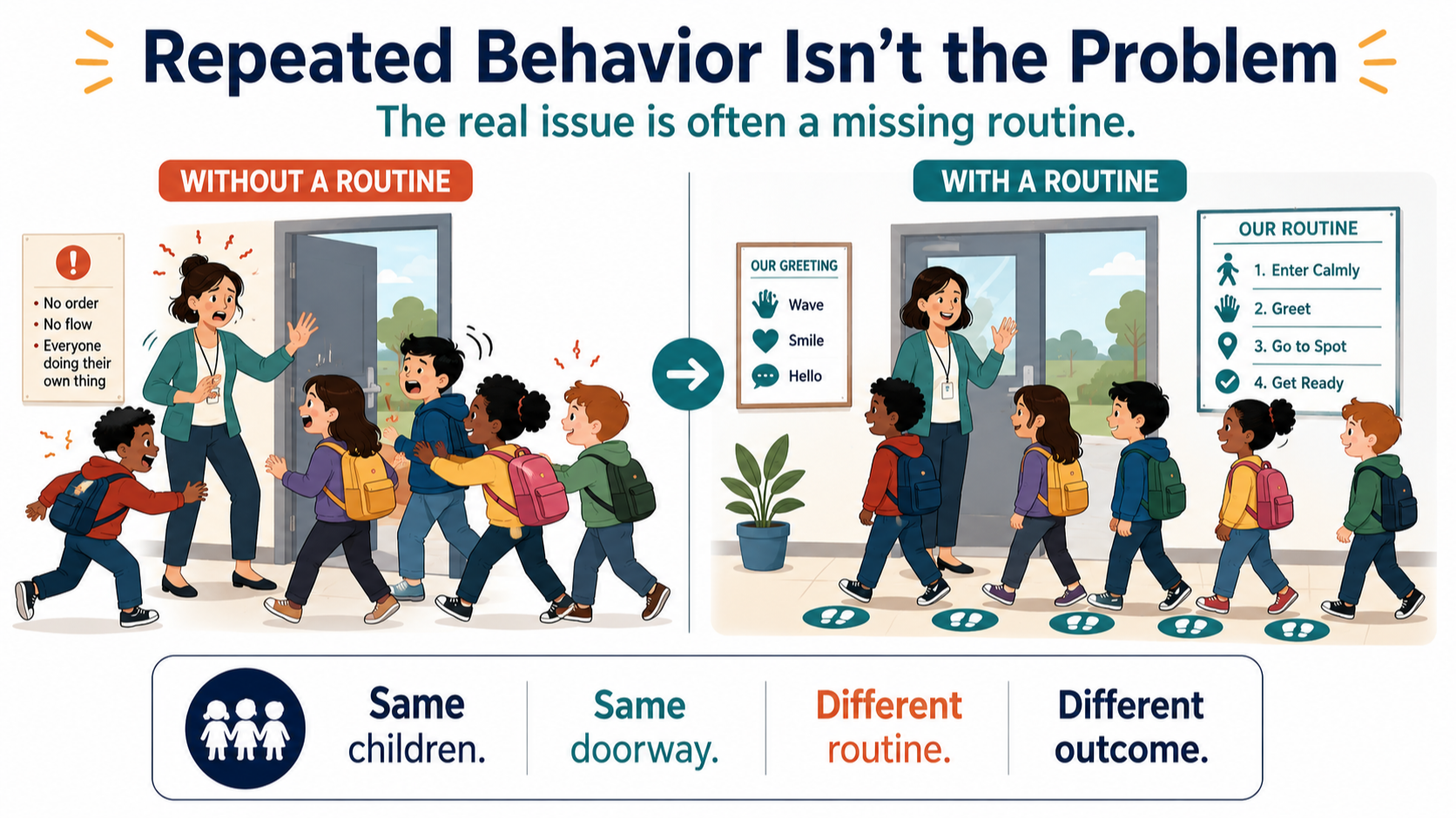
Return to that doorway. The collision that keeps happening at the same time, in the same place, between the same people, is not first of all a discipline problem. It is a design problem wearing the costume of one. When a behavior repeats on a schedule, it is telling you that the moment has no routine to run on, so it falls to a person to hold it together by attention and effort each time, and attention and effort are the two resources you have least of by the middle of the afternoon. A system is simply the routine you build so that the right thing happens by arrangement rather than by force, and once it is in place it grows the very skill you kept correcting for.
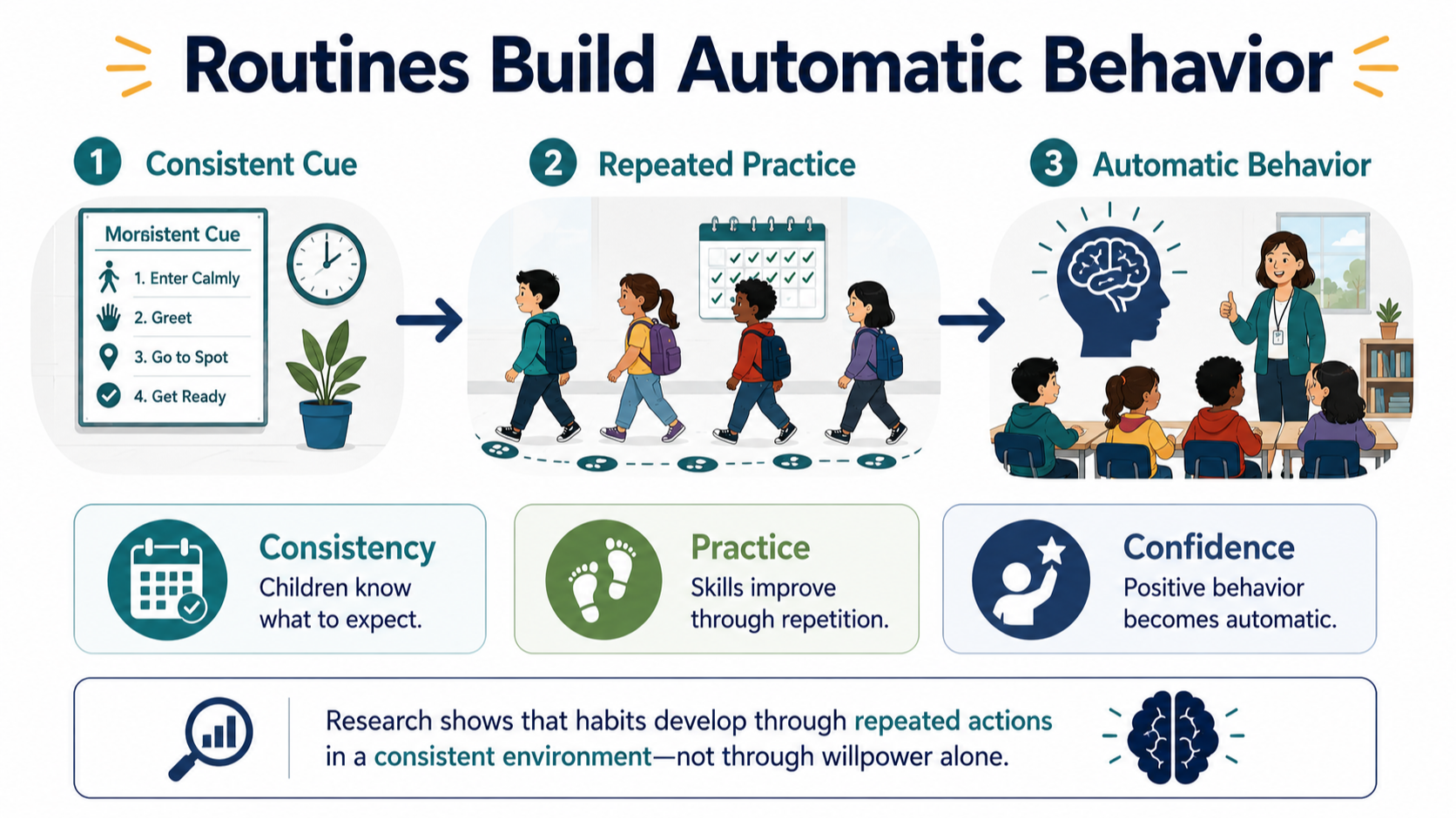
How routines take hold has been measured. In one study, researchers asked volunteers to adopt a new daily behavior in a consistent setting and tracked how automatic it became across twelve weeks. The behavior grew more automatic through simple repetition in a stable context, climbing gradually rather than through effort or motivation, and a single missed day did little to set the process back (Lally, van Jaarsveld, Potts, & Wardle, 2010). What made the behavior hold was not willpower but the pairing of a consistent cue with enough repetitions, which is precisely what a program routine gives a child or a staff member who cannot yet produce the behavior on demand.
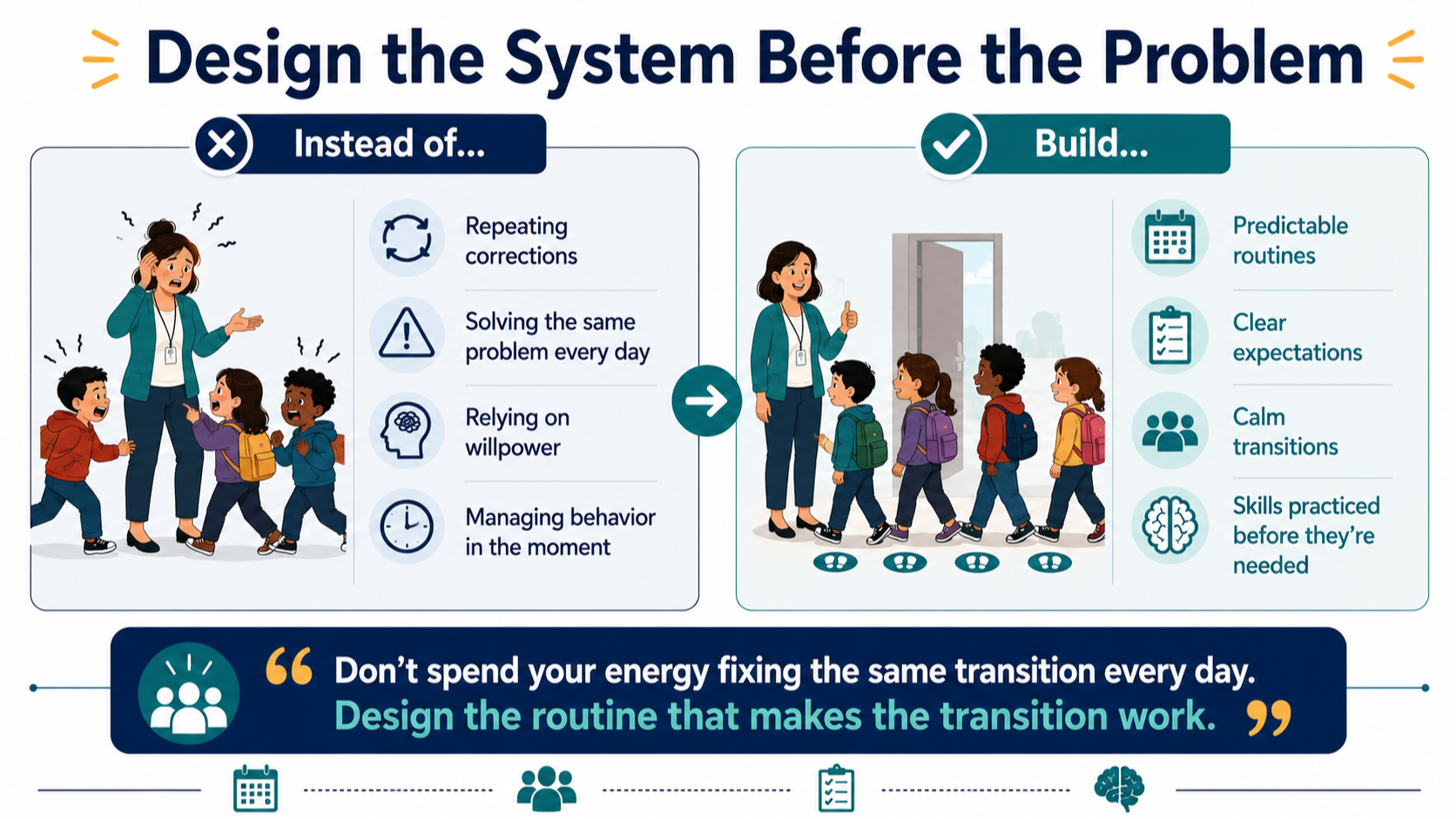
The second finding speaks directly to where you spend your energy. Researchers observed six primary grade teachers across a year and compared the two whose rooms produced the most engagement and learning with the four whose rooms produced less. The most effective teachers spent the first days of the year establishing routines and procedures, so that by mid-year their rooms largely ran themselves, while the less effective teachers were still managing behavior in the moment, correction after correction (Bohn, Roehrig, & Pressley, 2004). The difference in outcomes did not come from stricter discipline. It came from systems built in advance, before the hard moment arrived, rather than reactions delivered inside it.
For you, this changes where your effort actually pays off, which is upstream of the flashpoint rather than inside it. The energy you now spend repairing the same transition can be spent once, on designing the routine that makes the transition run, and the same logic holds for your staff, whose repeated missteps are usually a sign of a missing procedure rather than a missing willingness. When you build the routine ahead of time, you are not lowering your standard. You are teaching the skill in calm practice instead of demanding it in the hard moment, and a skill taught in calm repetition is the only kind that holds up under pressure.
Source and reading: Lally, P., van Jaarsveld, C. H. M., Potts, H. W. W., & Wardle, J. (2010). How are habits formed: Modelling habit formation in the real world. European Journal of Social Psychology, 40(6), 998-1009. Bohn, C. M., Roehrig, A. D., & Pressley, M. (2004). The first days of school in the classrooms of two more effective and four less effective primary-grades teachers. The Elementary School Journal, 104(4), 269-287.
ONE SYSTEM, BUILT STEP BY STEP
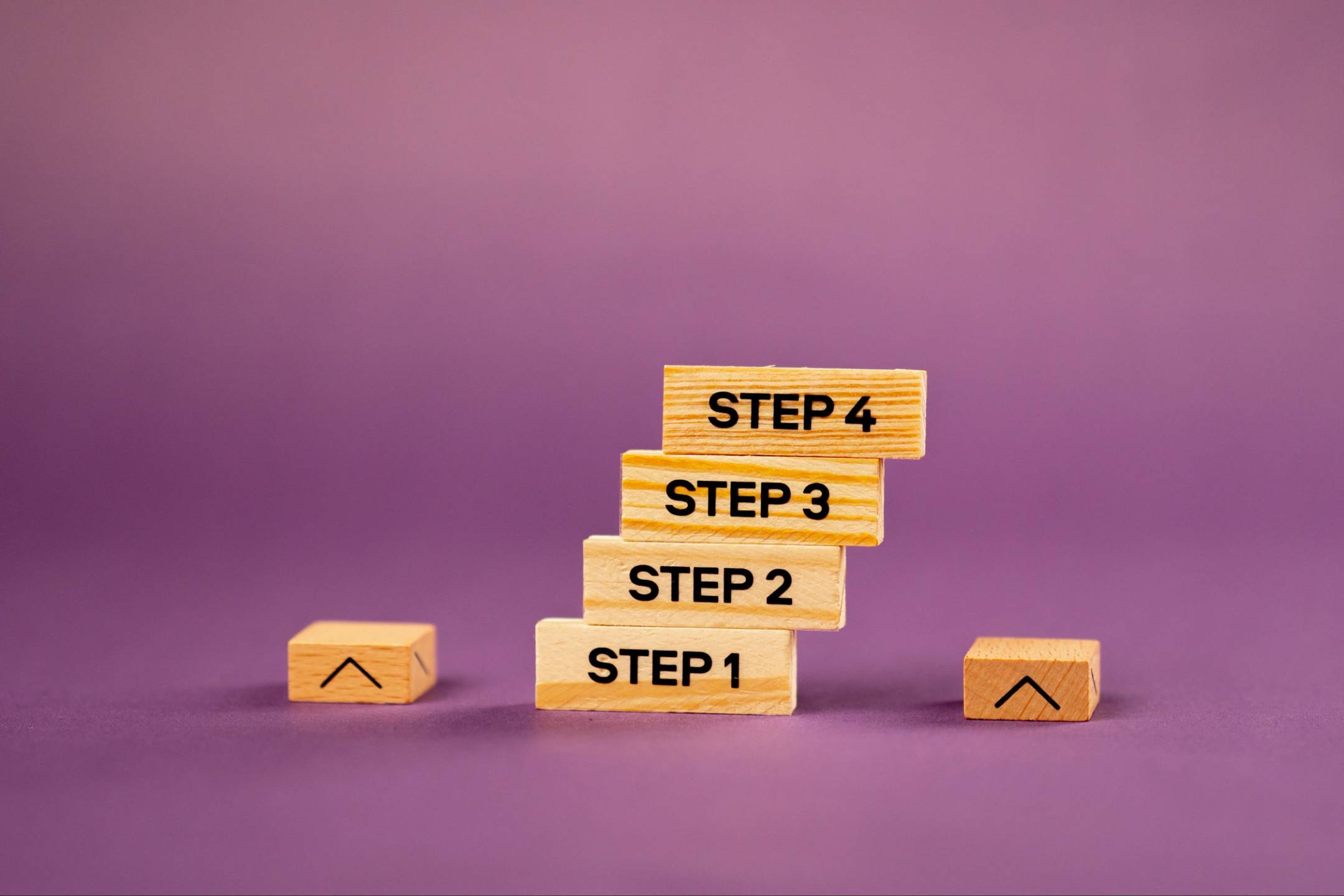
Here is a single routine, drawn from the systems chapter of Beyond Supervision, built the way you would build it in your own program. Take the one transition that comes apart most often and follow it through these four moves.
Begin by naming the routine in concrete, observable terms, not as a goal but as a sequence anyone could follow. Rather than asking the room to move to free play calmly, define the three moves that make it calm: children clear their table, walk the inside path to the door, and wait behind the blue line until a staff member opens it. A routine that a new staff member could run on their first day is a routine, and anything vaguer than that is still a wish.
Next, decide the cue that starts it and the adult who owns it. Attach the sequence to a fixed signal, the same chime or the same words at the same time and assign one staff member to stand at the door and run it, in place before the transition begins rather than arriving once it has already turned. A routine without an owner reverts to whoever happens to be closest, which is how the moment came apart in the first place.
Then teach it in the calm, before you ever need it. Walk the children and the staff through the sequence when nothing is at stake, name it again the next day, and expect to repeat it far longer than feels necessary, because repetition in a stable setting is what turns a taught sequence into an automatic one. The first study above puts real numbers behind the patience this asks of you.
Finally, watch what the routine produces and adjust one element at a time. If the line still tangles, change the path rather than the whole system, and give that change the same handful of repetitions before you judge it. A system is not a rule you impose once. It is a design you refine by reading what it returns to you, which is the very work the next issue takes up.
One Small Step this Week
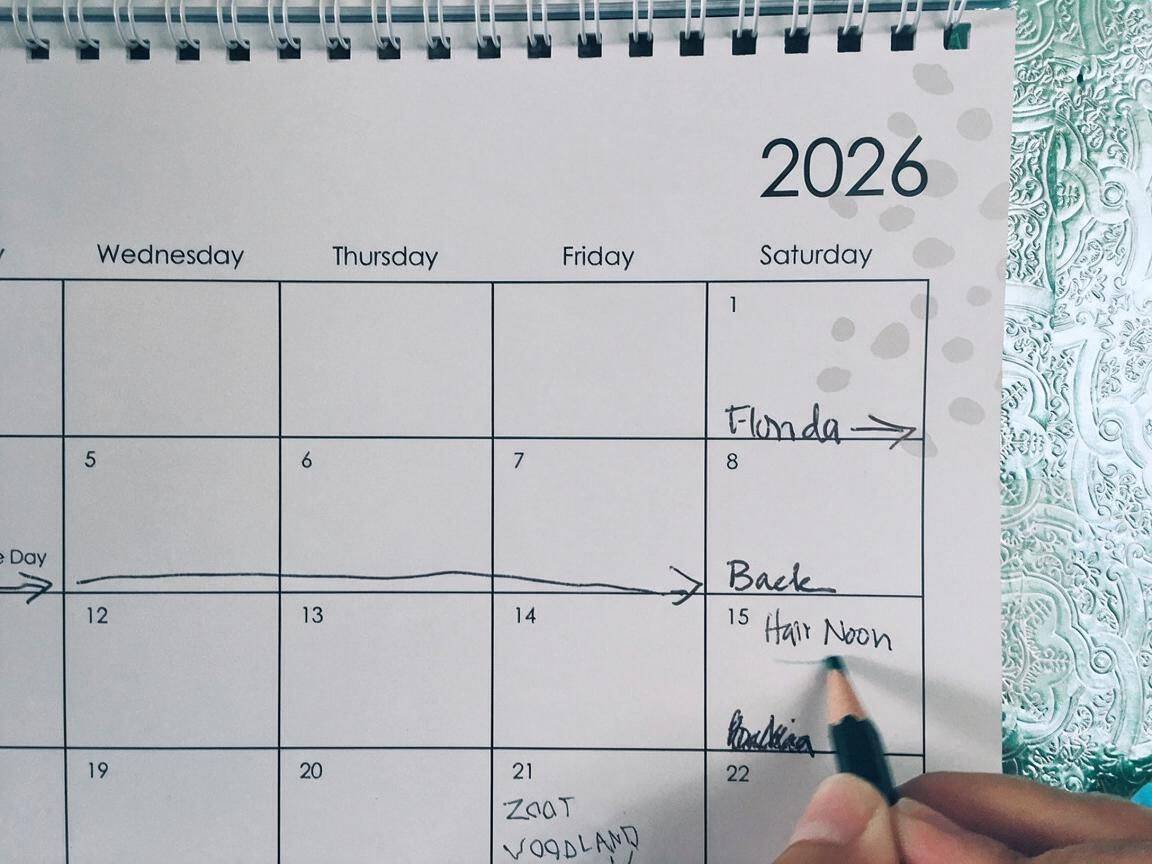
This week, choose the one transition or recurring behavior that most often pulls you in to manage it by hand. Rather than correcting it one more time, sit down for fifteen minutes with the staff who work that moment and design a single routine for it, naming the sequence, choosing the cue, and assigning the owner. Building the routine before the next hard moment, instead of repairing the moment yet again, is a program decision, and it is the point at which you stop paying for the same problem twice.
What Staff Are Saying About From Our Training
Our workshop, Resposible Leadership: Emotional Inteligence, in the words of the staff who took it.
Dignity of Children leads professional development workshops for afterschool and youth program staff, built on the same practices:
Responsible Leadership: Emotional Intelligence
This workshop is designed for educational leaders who want to develop their capacity to lead with purpose and emotional intelligence. Through the course, participants will explore the importance of having a clear sense of purpose and learn techniques for creating a learning culture in the classroom. They will also develop their conflict management skills and gain insights into why compassion is essential in leadership. The course includes a workbook specifically designed for educational leaders to help them enhance their emotional intelligence and become more effective and responsible leaders. Throughout the training, participants will engage with thought-provoking videos by speakers who are recognized experts in the fields of emotional intelligence and responsible leadership. By the end of the course, participants will have developed a greater understanding of how to lead with purpose, develop their emotional intelligence, and become more effective and responsible leaders. They will be equipped with practical skills and tools that they can apply in their work to create a positive learning culture and foster more compassionate, responsible, and effective leadership.
To bring a workshop to your team, book a conversation at dignityofchildren.com/afterschool-staff-workshops.
"Everything was amazing. The training taught me a lot of valuable information that I will carry on in my leadership style and growth within the organization."
— Shawn, Vanderbilt YMCA
"This workshop was fantastic because it reminded us of our purpose, not only in our jobs, but also with our colleagues and participants. It was a great way to feel grounded and have those simple reminders."
— Karla, Vanderbilt YMCA
PARTNER HIGHLIGHT
We Cannot Do This Work Alone
As we focus on building intentional systems this week to protect your time and energy, we are thrilled to feature our partner, AfterSchool HQ.
When administrative workflows rely entirely on manual effort, they rapidly drain the team energy your program depends on. If your staff is still tracking attendance by hand, chasing down physical registration forms, or managing payment collections, you are fixing operational design problems with your limited personal time. AfterSchool HQ is a purpose-built youth organization management platform designed to replace these exhausting, paper-heavy tasks with automated software systems.
Their platform supports your program's day-to-day operations through three automated pillars:
- Online Registrations and Payments: Families can easily discover activities, complete forms, and submit payments through a seamless digital portal, removing manual front-desk friction.
- Centralized Student Tracking: Staff gain immediate access to vital student records, automated waiting lists, and digital check-in/check-out tools to keep everyone aligned.
- Real-Time Impact Reports: The software simplifies data collection, centralizing both quantitative and qualitative metrics automatically so you can present clear results to funders without sacrificing hours of direct service time.
For programs that want a truly effortless transition, their Autopilot Implementation Service allows your organization to hand off the entire technical setup, data migration, and enrollment configuration to a dedicated support team.
Beyond their management software, AfterSchool HQ has intentionally built a highly engaged ecosystem for afterschool professionals. They host their dedicated network on Circle, a premier platform for modern interactive groups. Exploring their platform provides a firsthand look at how a masterfully organized community space can cultivate deep provider engagement, encourage continuous learning, and foster peer-to-peer resource sharing.
You can experience this network yourself and access their exclusive tools, forums, and ongoing support networks by visiting the official page to explore and join the AfterSchool HQ Membership.
TRENDS IN YOUTH DEVELOPMENT
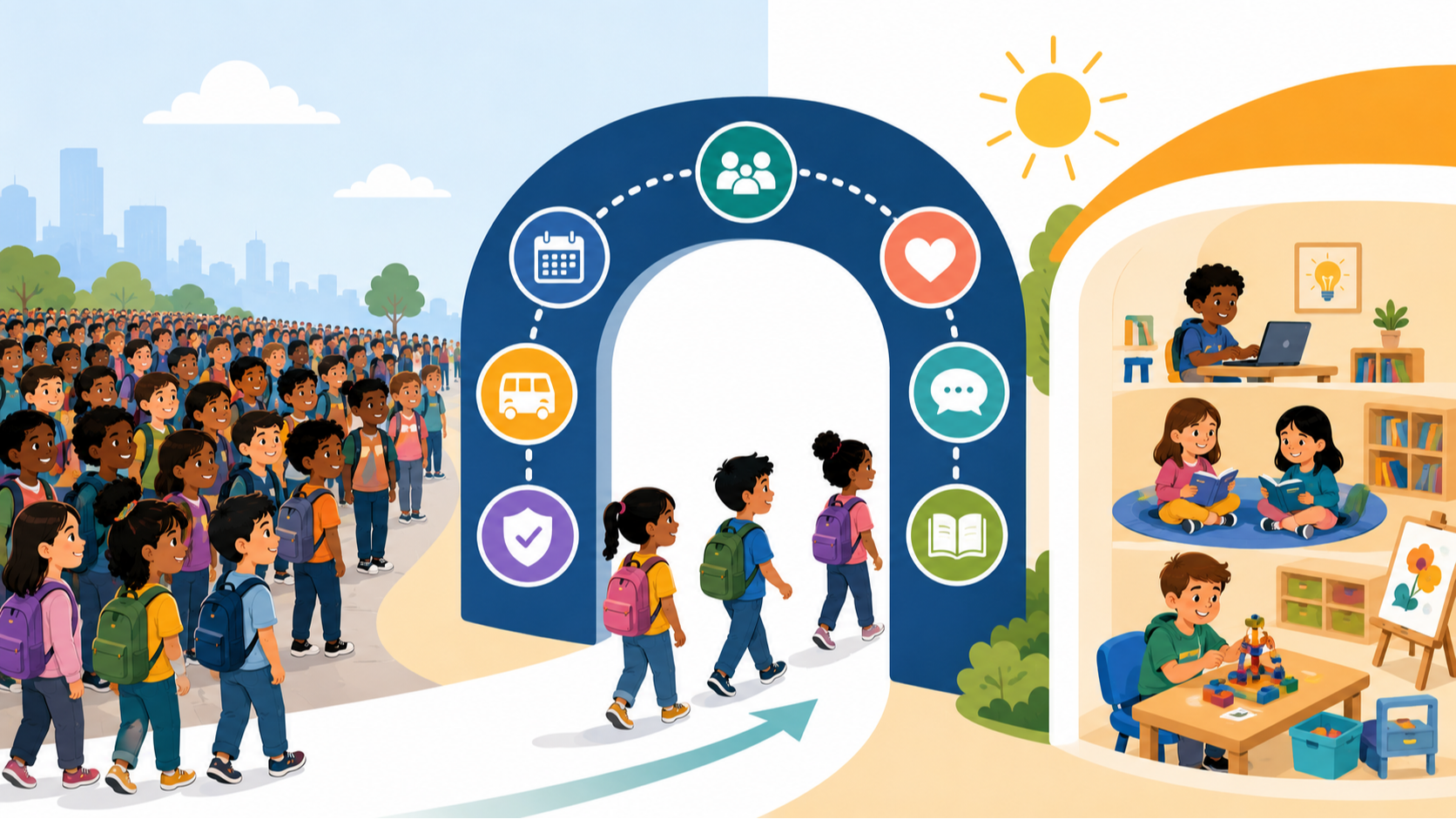
The demand for afterschool has rarely been higher, and access has rarely been more strained. In its fifth edition of America After 3 PM, released in December 2025, the Afterschool Alliance reported that the parents of nearly thirty million children want an afterschool program for them, yet more than three-quarters of those children, roughly twenty-two million, cannot get into one, with unmet demand among middle schoolers reaching an all-time high (Afterschool Alliance, 2025). The finding sits close to this week's focus. When need this far outruns supply, the programs that already exist carry more weight than ever, and what lets a program serve more children well and keep the ones it has is rarely a burst of extra effort. It is the strength of its systems, the routines that let good staff deliver a reliable experience day after day without depending on anyone being at their best every single time. Building those routines is not administrative housekeeping. It is how you widen the door for the children still waiting outside it.
Source and reading: Afterschool Alliance. (2025). America After 3PM: Demand grows, opportunity shrinks. Retrieved from afterschoolalliance.org/AA3PM
JOIN ME IN CELEBRATING MY MILESTONE
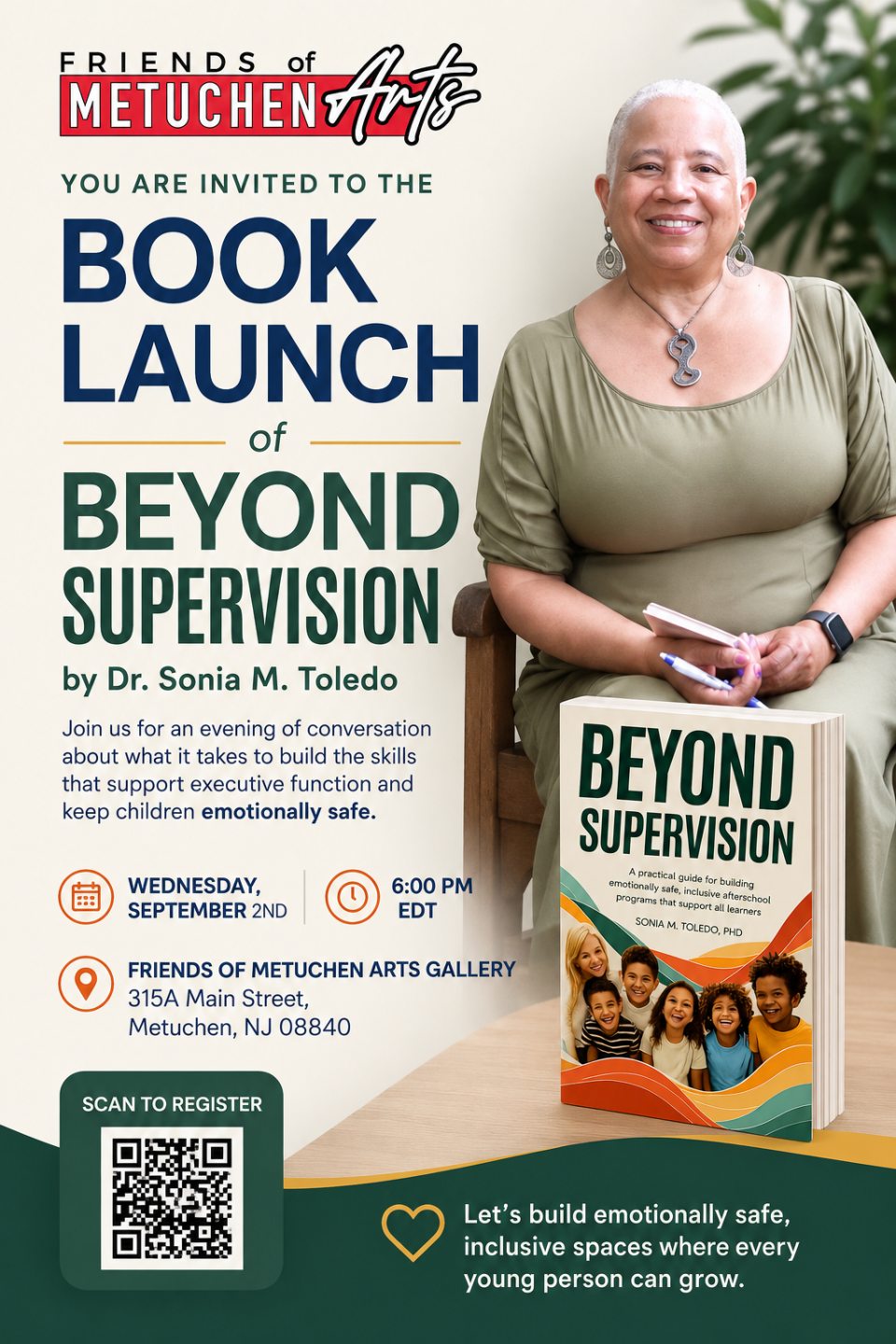
Beyond Supervision walks through all five links of the From Belief to Outcomes framework: Belief, Nervous System, Executive Function, Systems, and Outcomes. Buy the book here. If it has helped your practice, leave a review here.
A Question to Carry into the Week
What is one thing I will protect for myself this week, so I have something left to give the children I serve?
With dignity and purpose,
Dr. Toledo
Sonia Toledo, PhD · Founder and CEO, Dignity of Children · Author, Beyond Supervision
P.S. If this issue named something real about your week, forward it to one colleague or leader who works the same repeating afternoons you do, and invite them to sign up for The Weekly Practice so it reaches them directly each week. (add the link to opt-in to the newsletter here)



Join the Safe to Thrive movement HERE
Get your Copy Beyond Supervision
Enroll to Lead with Heart & Mind: 6-Week Guided Transformational Journey HERE
Book Professional Development Workshops for Educators HERE
Book Professional Development Workshops for Leadership HERE
Register for Director's Lab 2.0 - a program for Supervisors and Directors
To discuss your training needs, schedule a one-on-one consultation with me HERE
Dignity of Children
The Weekly Practice · Building quality through discipline, adjustment, and consistency.