DIGNITY OF CHILDREN · DR. TOLEDO
The Weekly Practice
Issue No. 05 Week of July 21st, 2026 Theme: Nervous System
A Message to the Program Leader
Here is what I want you to hold onto this week. The culture of your program will not arrive from a new schedule or a firmer set of consequences. You will set it, because your staff takes their reading of each moment from you, and your children take theirs from your staff. That is the most dependable influence you have, since it is the one you can use today without waiting for anyone's approval. It is also why your own regulation is part of the program culture rather than a private wellness matter. A leader whose nervous system stays settled under pressure makes clearer decisions, corrects staff without inflaming them, and gives an entire room a calmer system to draw on.
So, the practice I am asking of you this week is self-regulation, worked on yourself before anyone else. In the next tense moment, place your attention on your own exhale, let your shoulders fall and your voice drop by a degree, and notice what your own body is doing before you ask a child or a staff member to change what theirs is doing. This week's focus is the nervous system, the second link of the From Belief to Outcomes framework, and it begins with yours.
With dignity and purpose,
Dr. Toledo
Sonia Toledo, PhD, Founder and CEO, Dignity of Children, Author, Beyond Supervision
Next week: once your body is settled, how to find the specific skill that is actually missing under a child's behavior. We move on to the third link of the framework: executive function.

THIS WEEK'S FOCUS:
Nervous System
You hold more influence in a hard moment than any policy in your binder, and most of it moves before you say a word. In the pause before you respond, the children are already reading your body. Your rate of breath, the set of your jaw, the pace of your steps across the room, all of it reaches them ahead of any instruction, because a young nervous system is built to read the nearest adult for a signal about whether the moment is safe. This is not a figure of speech. It has been measured.
In one study, researchers placed mothers under social stress in a laboratory, then reunited them with their infants and tracked the heart rate of both. Within minutes the infants' physiology moved toward their mothers', so that a mother's stress response registered in her baby's body without a word passing between them (Waters, West, & Mendes, 2014). The state of the adult crossed directly into the child, carried by proximity rather than by anything that was said.
The same current runs through a program room, and it scales. In a study of elementary classrooms, researchers measured children's morning cortisol, a physiological marker of stress, and found it was elevated in rooms where teachers reported greater burnout (Oberle & Schonert-Reichl, 2016). The adults' depletion was surfacing in the children's stress chemistry before anyone could name what was wrong. A dysregulated adult does not simply manage a stressed room. Without intending to, that adult helps produce it.
For you as the leader, this is not one more reason to watch yourself anxiously, because anxiety is itself a state the room will catch. It points the other way. Since your state is already traveling into the room whether or not you attend to it, the most efficient place to intervene in a hard moment is your own nervous system first. When you settle your body, you are not stepping away from the discipline problem. You are working on the layer beneath it, the one that determines whether the children in front of you can reach the level of thinking you are about to ask of them. Adult regulation comes before child regulation, every time.
Source and reading: Waters, S. F., West, T. V., & Mendes, W. B. (2014). Stress contagion: Physiological covariation between mothers and infants. Psychological Science, 25(4), 934-942. Oberle, E., & Schonert-Reichl, K. A. (2016). Stress contagion in the classroom? The link between classroom teacher burnout and morning cortisol in elementary school students. Social Science & Medicine, 159, 30-37.

A SIXTY SECOND RESET BEFORE THE HARD MOMENT
When you feel the room begin to tighten and you have a breath before you step in, run this short reset on yourself. It takes about a minute, and it works on your own body rather than on the children.
- Lengthen one exhale for a count of 4. Breathe out slowly for a count of six, longer than your inhale, which is the signal that tells your own system the situation is survivable.
- Drop and widen. Let your shoulders fall, unclench your jaw, and soften your gaze to take in the whole room instead of fixing on the one child. A wide field of vision calms the body faster than a narrow one.
- Name your state, then choose your entrance. Note privately what you are feeling, then decide on the tone you want to carry. Walk in at that tone rather than at the one the moment handed you.

One Small Step this Week
Find the one transition that most reliably raises the intensity in your program, whether that is the move to the gym, the shift from snack to homework, or the first ten minutes of pickup. This week, place yourself and one staff member there before it begins, settled and in position, so you shape it rather than manage it after it escalates. Where your calm adults stand in, that window is a program of choice, and it does more than any correction after the fact.

What Staff Are Saying About From Our Training
Our workshop, Promote a Trauma-informed Care Enviroment, in the words of the staff who took it.
Dignity of Children leads professional development workshops for afterschool and youth program staff; built on the same practices this newsletter works through:
Promote a Trauma-informed Care Environment
This workshop aims to equip learners with the necessary tools to establish and sustain a nurturing and responsive culture for individuals who have endured trauma. This comprehensive training encompasses crucial aspects of a trauma-informed approach, such as identifying trauma indicators, comprehending its influence on behavior, and fostering secure and supportive spaces that facilitate healing and recovery for affected individuals.
To bring a workshop to your team, book a conversation at dignityofchildren.com/afterschool-staff-workshops.
"The instructor was extremely detailed and interacted heavily with staff. He included his own experiences to explain the material, as well as asking us for our experiences to relate to the topic."
— Ania Atik, NYJTL
"This training was extremely informative. The presenter was amazing and engaging."
— Makeda Savice, NYJTL
PARTNER HIGHLIGHT
We Cannot Do This Work Alone
None of us builds a strong program in isolation. The leaders who go the furthest are the ones who surround themselves with partners, resources, and people who strengthen the work. Each week we will introduce a new partner you can add to your own resources, so that over time you build a network you can lean on instead of carrying everything yourself.
This week's partner is Two by Two Character Development.
Two by Two Character Development is a nonprofit organization that equips schools and youth-serving organizations with engaging, hands-on character education and social-emotional learning experiences. Through rescue-inspired stuffed cats and dogs, interactive lessons, and professional learning, Two by Two helps children build empathy, responsibility, kindness, and the relationship skills they need to thrive.
Core Focus Areas
- Building empathy, kindness, and compassion
- Strengthening social-emotional and character development
- Developing responsibility and positive decision-making
- Creating caring, connected school and youth communities
Signature Programs
- Kindhearted Kids® – Rescue-inspired stuffed cats and dogs that help children practice empathy, responsibility, and life skills through memorable, hands-on experiences.
- Kindhearted Kids® – Meet the Challenge – A collaborative, station-based character education experience where students work together to solve challenges while building teamwork, empathy, perseverance, responsibility, and problem-solving skills.
- Character Connections® – Flexible classroom and small-group resources that reinforce character, social-emotional learning, and relationship-building throughout the school year.
- Professional Learning – Interactive workshops that provide educators and youth professionals with practical strategies to strengthen school culture, student engagement, and belonging.
Impact
- More than 20 years of empowering children through character education.
- Partnering with schools, afterschool programs, counselors, and youth organizations across 40+ states.
- Research-informed programs designed to help children develop the skills they need for success in school, relationships, and life.
Discover educational materials via the official Two by Two Store

TRENDS IN YOUTH DEVELOPMENT
Chronic absenteeism remains one of the defining challenges facing schools, with rates still sitting above their pre-pandemic level in districts across the country. A January 2025 issue brief from the Afterschool Alliance gathered the national evidence and reported that students in federally funded afterschool programs showed measurably fewer absences than similar peers who did not attend, and that nearly half of participating students who had been chronically absent the prior year improved their school day attendance (Afterschool Alliance, 2025). What the brief credits is not a tougher attendance policy, but the presence of supportive adults and a culture of care that young people want to return to. That is worth holding alongside this week's focus, because the regulated adult you are practicing to be is precisely the adult a child returns to. Your own calmness is not only a way to manage behavior. It is, quietly, an attendance strategy.
Source and reading: Afterschool Alliance. (2025, January 17). New issue brief: Afterschool programs are helping combat chronic absenteeism by keeping students engaged. Retrieved from afterschoolalliance.org
READ THE FULL FRAMEWORK
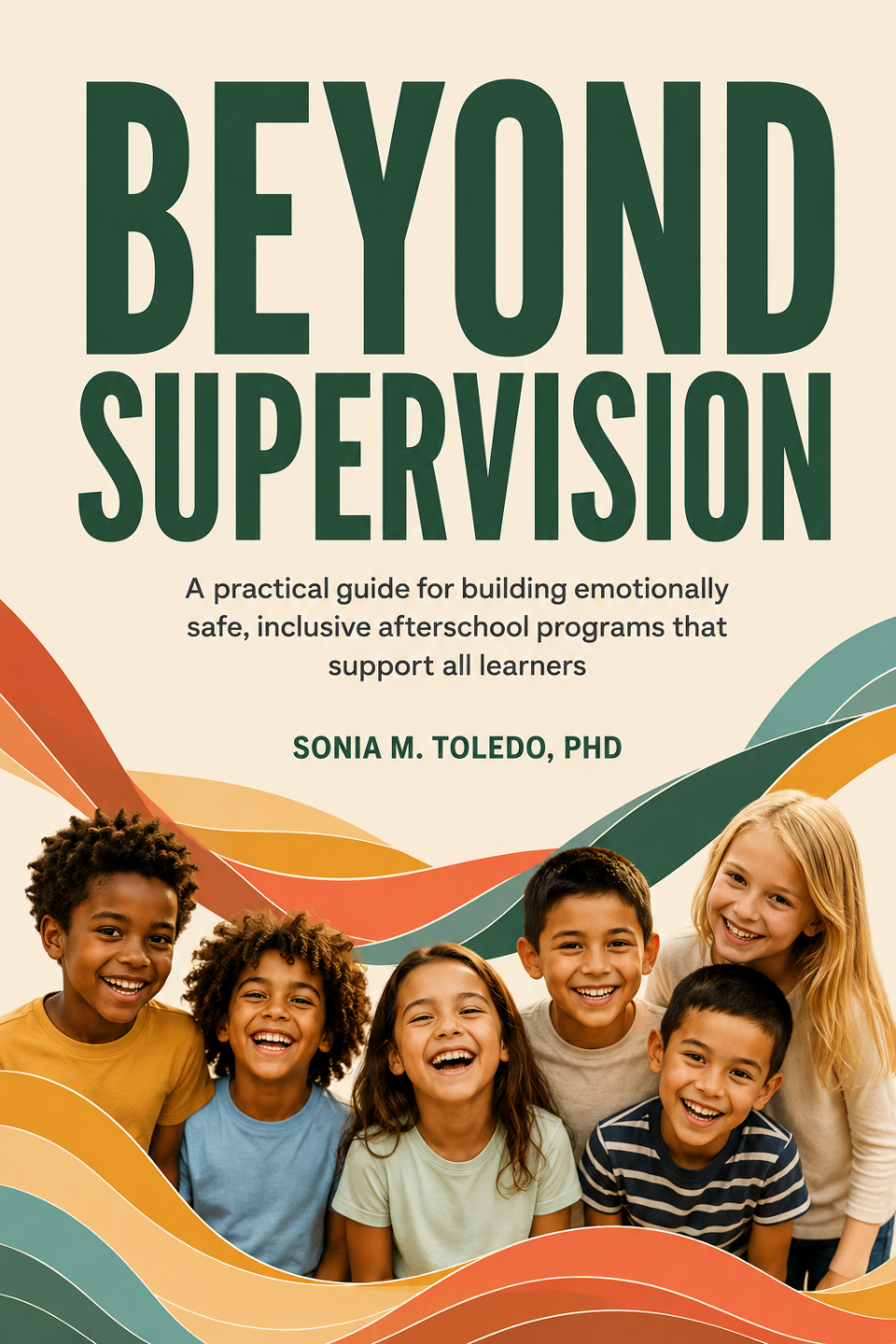
Beyond Supervision walks through all five links of the From Belief to Outcomes framework: Belief, Nervous System, Executive Function, Systems, and Outcomes. Buy the book here. If it has helped your practice, leave a review here.
A Question to Carry into the Week
When the room tightens, what is my own body doing in the seconds?
With dignity and purpose,
Dr. Toledo
Sonia Toledo, PhD · Founder and CEO, Dignity of Children · Author, Beyond Supervision
P.S. If this issue named something real about your week, forward it to one colleague or leader who carries the same crowded window you do, and invite them to sign up for The Weekly Practice so it reaches them directly each week.


Join the Safe to Thrive movement HERE
Get your Copy Beyond Supervision
Enroll to Lead with Heart & Mind: 6-Week Guided Transformational Journey HERE
Book Professional Development Workshops for Educators HERE
Book Professional Development Workshops for Leadership HERE
Register for Director's Lab 2.0 - a program for Supervisors and Directors
To discuss your training needs, schedule a one-on-one consultation with me HERE
Dignity of Children
The Weekly Practice · Building quality through discipline, adjustment, and consistency.