DIGNITY OF CHILDREN · DR. TOLEDO
The Weekly Practice
Issue No. 03 Week of July 07, 2026 Theme: Transitions and Trust
A Message to the Program Leader
Your calm is the most flexible tool you have. On a long summer day, it is also the most tested. When you lead from a grounded, confident place, you do not brace against the hours. You flex with them. You read what the day is asking of you and your staff, and you tighten the system to meet it. That is not extra work laid on top of summer. That is the work.
This issue is about transitions and trust. A transition is any moment the ground shifts under someone: the end of a long, hot day, staff is out, and the plans need redrawing. Trust is what lets people move through the shift without bracing for the worst, and it thins when they feel you're anxious or flustered about the challenges. Build systems that let your staff and children help carry the transitions rather than endure them, and the room begins to hold itself.
With dignity and purpose,
Dr. Toledo
Sonia Toledo, PhD · Founder, Dignity of Children · Author, Beyond Supervision
SECTION 1 · THE FRAMEWORK
From Belief to Outcomes
A review of Beyond Supervision
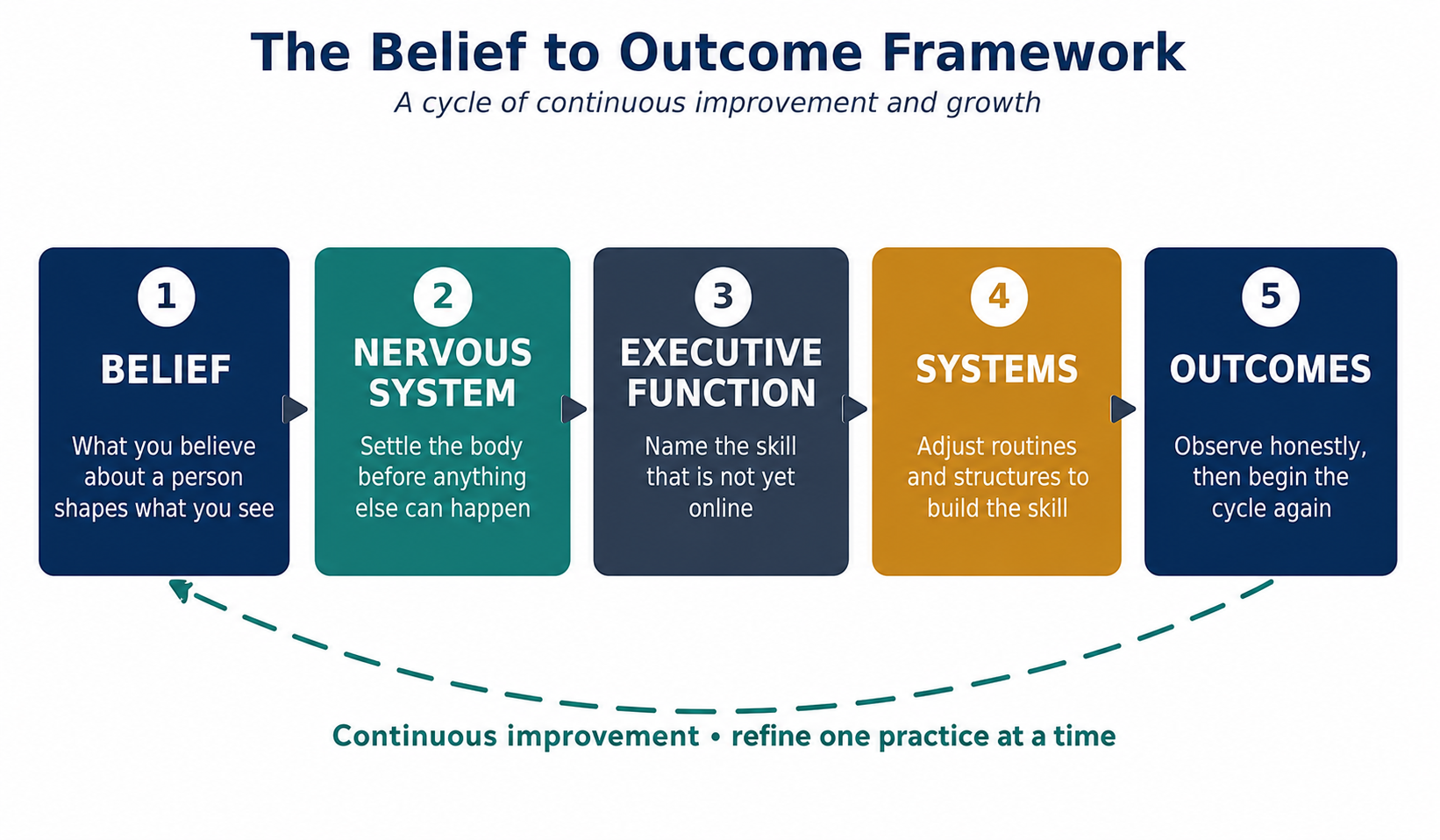
Beyond Supervision lays the foundation for everything that follows: the From Belief to Outcomes framework. I built this framework from my own learning process, because I needed to understand why I could be fully capable of something and still struggle to do it. What I came to see is that emotion and learning capacity are linked, and that the link runs through the nervous system, through executive function, and through the systems we build around ourselves. The framework is not a one-time fix. It is built on continuous improvement and growth, for you as the leader, for your staff, and for the children, and each pass through it makes the next pass steadier.
The framework moves in order, one link at a time, because each link makes the next one possible.
Belief, and how belief shapes outcomes. Everything begins with what you believe about a person and about yourself. When you believe a child who resists a transition is overwhelmed by the change rather than choosing to be difficult, you respond as someone who can make the change safer, not as someone who has to enforce it. The same belief applied to trust changes how you read a child who tests every limit. You stop asking why they will not comply and start asking what would make you worth trusting in that moment. Belief is not wishful thinking. It is the lens that decides what you see and how you respond.
Addressing the nervous system. A belief opens the door, but a settled nervous system is what lets anyone walk through it. Trust cannot form in a body that is braced for the next disruption. Before a child can accept a change, rely on an adult, or lower their guard at all, the body has to feel safe enough to do it. The same is true for you and your staff. No one extends trust while still in alarm, which is why we settle the nervous system first, ours and then theirs.
Identifying which executive function is missing. Once the system is calm, you can name the specific skill that is not yet accessible, whether it is impulse control, emotional control, flexible thinking, working memory, or planning. A child who comes apart at every transition is not being manipulative. They are often short on the flexible thinking that a change demands. Naming the missing skill turns a behavior problem into a teachable target.
Adjusting the systems to build executive function skills. Skills do not grow through correction in a hard moment. They grow through systems, the routines, structures, and daily practices that give a skill room to develop through small repetitions. A predictable transition routine, a visual warning before a change, and a consistent adult a child can count on are all systems. This is where your leadership lives, in the structures you design and keep adjusting.
Observing the outcomes that result. Outcomes are not wishes. They are what a steady system produces over time. You observe them honestly, then you begin the cycle again, refining one practice at a time. That is why this is a framework for continuous growth and not a checklist you complete once.
BOOK LAUNCHED · JUNE 30, 2026
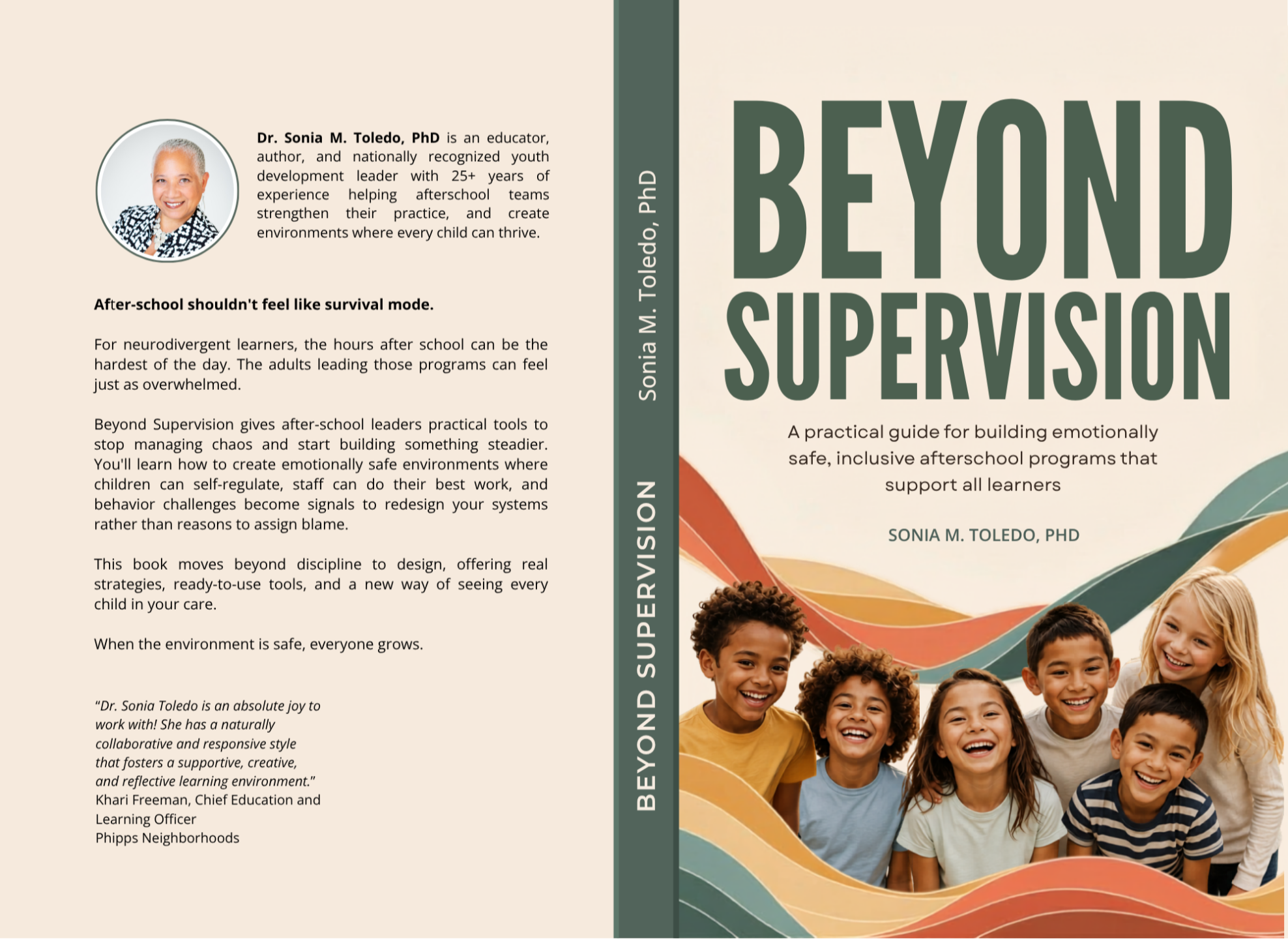
Beyond Supervision
My book, Beyond Supervision, is a practical guide for after-school leaders who want emotionally safe, inclusive programs that work for neurodivergent children. And since we are all neurodivergent in our own way, it is really a guide for everyone. The framework, the stories, and the tools sit in one place, so a steady program no longer depends on who happens to be in the room that day.
You can read the full framework in the book. Get your copy of Beyond Supervision HERE
Please consider leaving a REVIEW.

SECTION 2 · THE BENEFIT
Systems That Support Staff
Developing Your Staff and Protecting Their Well-Being
The well-being of your staff is not a soft concern to attend to only when the schedule finally allows. It is load-bearing. The condition an adult is in when they walk into the room quickly becomes the condition of the room, and an adult who is depleted, anxious, or waiting for the next thing to go wrong has no steadiness left to lend anyone else. Trust among children is downstream of trust among the adults who lead them, and neither one runs on willpower for long. For that reason, treat the growth of your staff and the protection of their well-being as a single piece of work rather than two, and build it into how the program runs so that it does not fall to whoever happens to have the most stamina on a given day.
Adults need emotionally safe spaces for the same reasons children do, and those spaces are built the same way, through structure people can count on. In practice, that looks like check-ins meant to support rather than to spectate, expectations that hold steady from one supervisor to the next, planning time that is genuinely protected, and a culture where a mistake is treated as useful information rather than as a charge against the person who made it. Give your team honest room to shape how transitions are handled and to bring their own judgment into the work. An adult who is trusted to make real decisions extends that same trust to children, and a trusted adult is the one a child will actually reach for when the ground shifts.
Your own regulation is not a private matter that stays with you. Your staff takes their cues from your steadiness or your strain well before they register a word you say, and they settle or brace to match it. Understood honestly, that is less a weight to carry than a point of leverage. One of the most useful things you can do for your team this week is to protect your own footing and to put a system in place that restores you on a regular schedule, instead of asking yourself to lead from an empty tank and mistaking that for dedication.
One small step this week: build a simple visual for one transition your staff runs every day- dismissal or lunch- that lays out each step in order so no one has to hold the whole sequence in their head. When the routine lives on the wall rather than in a person's memory, staff stay grounded during the busiest moments, and children can see what comes next before anyone has to say it.
SECTION 3
An Emotionally Safe Environment for Everyone
Building Safety, and Knowing When to Adjust
An emotionally safe environment is one where every person, staff and child alike, can take a risk, ask a question, try something new, and get it wrong without losing their place in the community. That security is what trust depends on, and it is tested most during transitions. Safety is built through warmth and structure held together, predictable routines, boundaries delivered with dignity, and adults who stay steady when feelings get big. But safety is not something you establish once and check off. This work has to be continuously observed, with honesty and a real commitment to apply new tools when the ones you have are no longer serving the community. Honesty matters most, because it is tempting to decide the system is fine just because it was fine last month. The leaders who build the safest rooms are the ones willing to keep looking.
How do you know that systems need adjustments?
You know by watching behavior, because behavior is data rather than a verdict. When a system meets people's needs, you see steadiness, cooperation, and children who recover from change without unraveling. When a system is failing, you see dysfunction, and it shows up in both staff and children, most visibly at the seams of the day where one thing ends and another begins. The behaviors are not the problem to be punished. They are the signal telling you which system to build or adjust. Use the tables below to read the signal. Each observable behavior is paired with the system or skill to build.
In staff, watch for these signals this week:
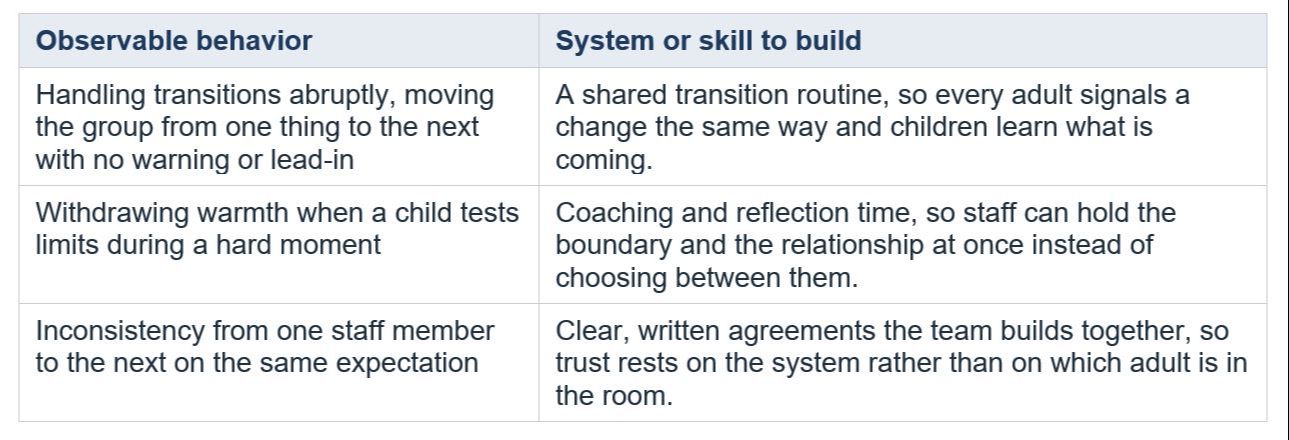
In children, watch for these signals this week:
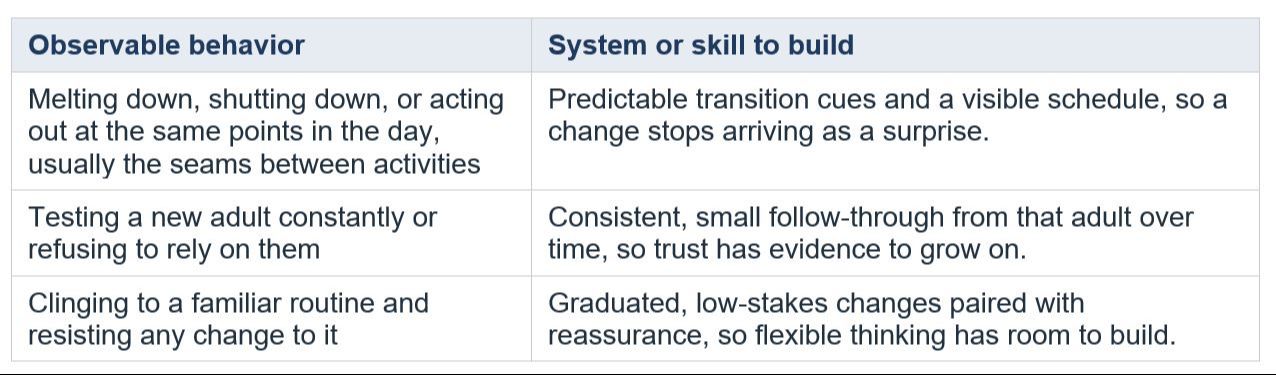
One small step this week: pick one point in the day where behavior reliably comes apart, look at the transition underneath it, and change one thing about how that transition is signaled. Then observe what happens over the week.
SECTION 4 · BULDING GROUP DYNAMICS
Choice, Creativity, and Self-Management
Group dynamics are not something that happens to you. They are something you design. The strongest group cultures rest on a simple principle: people invest in what they help create, and trust grows where people feel they have a say. When children and staff are reminded, through the actual structure of the day, that they have agency, the whole group settles and steadies, because helping to shape what happens feels different from being moved through someone else's plan. You build this through three kinds of systems, and each one hands a piece of ownership back to the group.
Offer choices. Bounded choice is one of the most powerful tools for steadiness you have. A choice board, an A-or-B option, or a menu of ways to complete the same task tells a child their preferences matter while keeping the structure intact. Choice is not the absence of boundaries. It is agency inside boundaries, and it gives a child something to control precisely when a transition takes other things away.
Invite creativity. When you let participants shape an activity, name a team, solve a problem their own way, or help decide how a change will be handled, you tap into strengths and judgment you would never reach by directing every step. This is the principle from the opening of this issue. The room gives back more than you could have produced alone, but only if you make space for it and protect the person who offers the idea.
Build self-management systems. Visual schedules, group agreements the participants helped write, jobs and roles that rotate, and progress trackers a child can run alone all do the same quiet work. They remind every participant that they are not waiting to be managed through the day. They are steering something of their own within a system they understand and helped shape, which is what makes change feel survivable rather than threatening.
Change under the build group dynamics. One small step this week: find one transition your staff currently manages entirely on their own, and hand part of it to the group of participants as a bounded choice or a shared job. Watch how ownership changes the way the group meets the change.

SECTION 5 · What Staff Are Saying About Our Training
What Staff Are Saying About From Our Training
Our workshop, From Distraction to Action, in the words of the staff who took it.
This section shares what staff are taking away from our training, in their own words. We begin with the From Distraction to Action workshops. From Distraction to Action: Boosting Students' Executive Function Skills is built for staff who run rooms where children struggle to focus, get organized, and follow directions. The workshop starts with the skills underneath the behavior: working memory, planning, and self-regulation, and shows how emotional growth makes all three possible. Staff leave with practical, repeatable moves for building a supportive, inclusive room that works for neurodivergent learners and for anyone whose executive function is still catching up.
Here is what staff are saying:
"This training was informative and engaging, providing practical knowledge and real-life examples that I can apply moving forward. It helped strengthen my understanding and increased my confidence in handling related situations effectively."
Ramses, Bronxworks
"extremely informative, showed me how to handle and manage behaviors and shows me that what I do will reflect off the children"
Treymaine, Bronxworks
"It is an excellent training refreshing concepts based on regulations of keeping children safe."
Melinda, Bronxworks
If you would like to plan professional development for your team, the From Distraction to Action workshop can be scheduled directly with us. A trained team is the most reliable system a program can have. Here is a list of our workshops

SECTION 6 · PARTNER HIGHLIGHT
We Cannot Do This Work Alone
None of us builds a strong program in isolation. The leaders who go the furthest are the ones who surround themselves with partners, resources, and people who strengthen the work. Each week I will introduce a resource you can add to your own toolbox, so that over time you build a network you can lean on instead of carrying everything yourself.
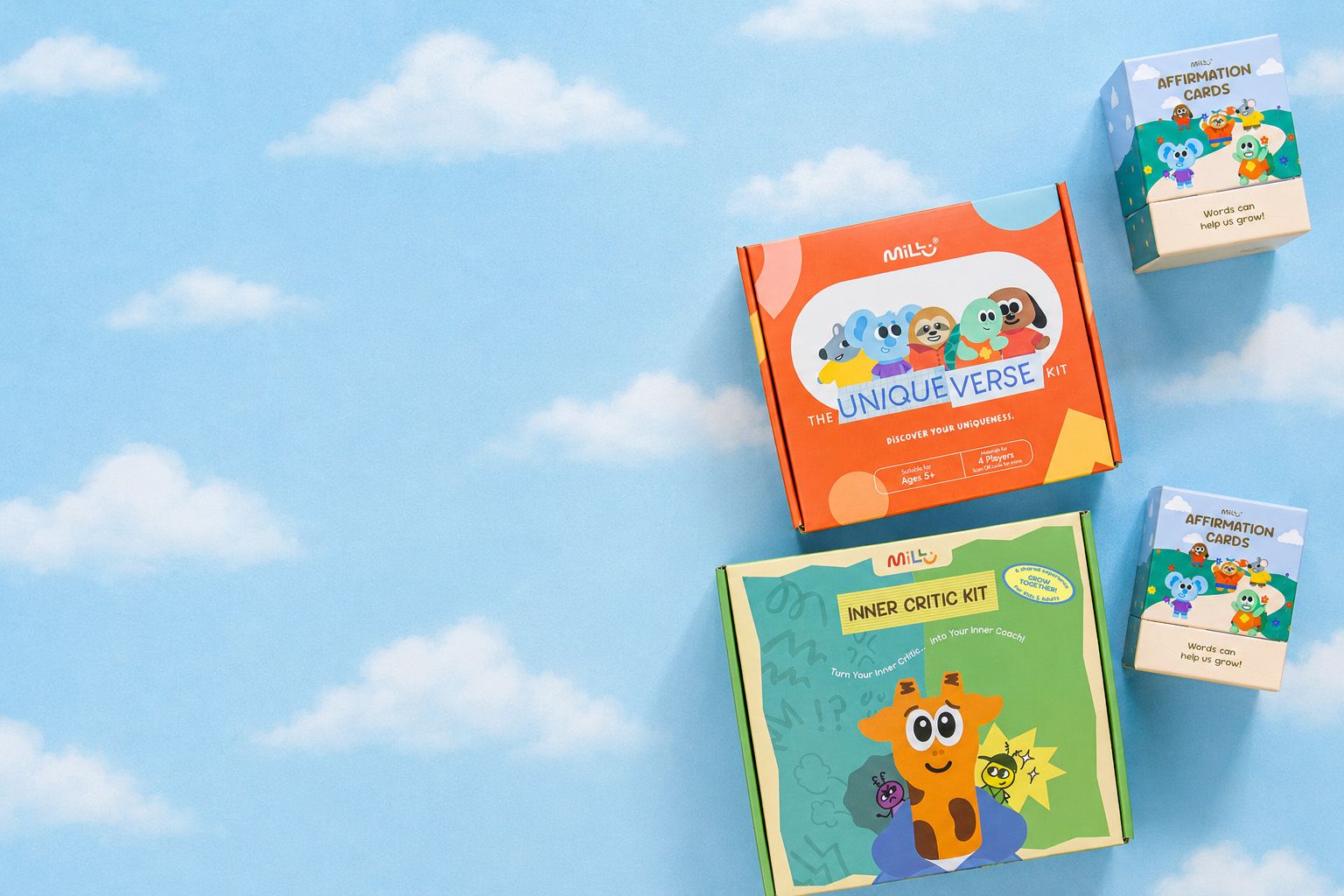
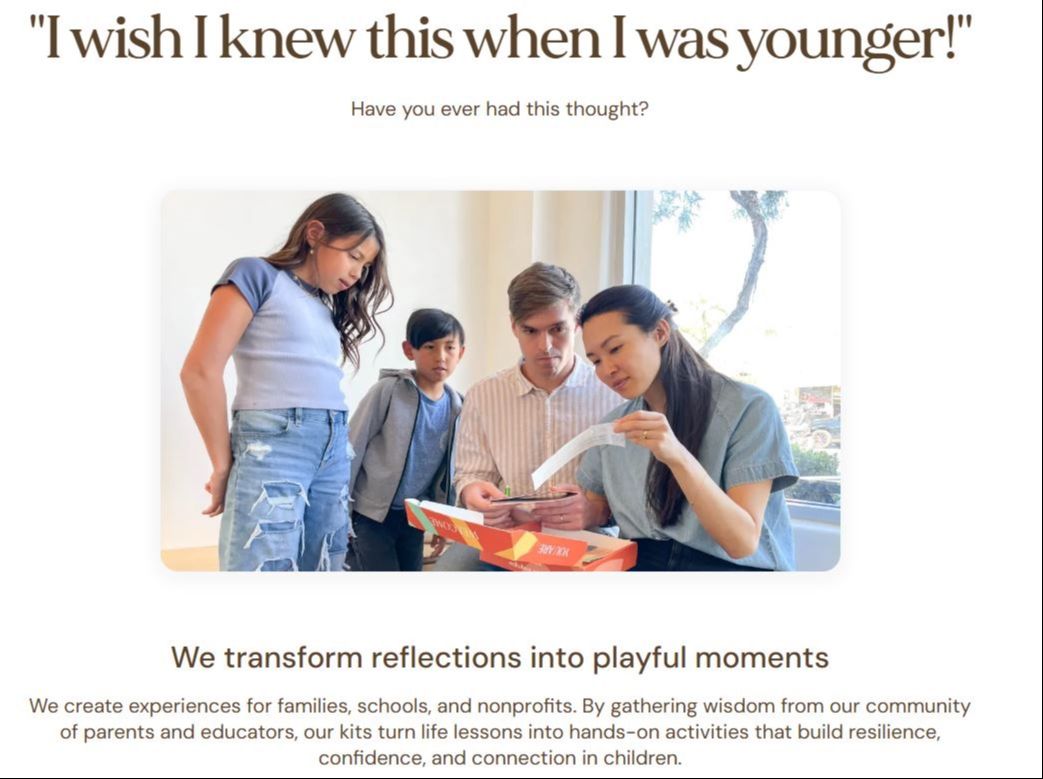
This week's partner is MILLU, a company that helps after-school programs turn important life lessons into engaging, hands-on experiences children remember.
Many program leaders know what they want to teach: belonging, emotional resilience, empathy, confidence, and healthy relationships, but finding activities that busy staff can facilitate consistently is another challenge. MILLU was created to bridge that gap.
Instead of asking staff to build social-emotional learning lessons from scratch, MILLU provides immersive, play-based experiences that transform big life concepts into meaningful moments of connection, conversation, creativity, and play.
Designed specifically for after-school and expanded learning programs, MILLU includes:
- 20-40 minute ready-to-facilitate sessions with everything needed to lead each experience
- A complete Facilitator Guide with step-by-step instructions, discussion prompts, and extension activities for your staff to gain confidence
- All physical materials included, eliminating hours of preparation
- Screen-free, hands-on activities grounded in play therapy, neuroplasticity, and experiential learning
- English and Spanish editions to better serve diverse communities
- Flexible implementation for after-school programs, summer learning, classrooms, and family engagement nights
- Professional development workshops that equip staff to create emotionally safe spaces where children can thrive
MILLU's flagship Uniqueverse Kit helps children discover that their uniqueness is a strength while building self-awareness, confidence, communication skills, and healthy peer relationships. Because every activity is experiential, children do more than learn these concepts—they practice them.
Trusted by organizations including YMCA programs, Boys & Girls Clubs, KIPP SoCal, school districts, and community organizations, MILLU offers a practical way to make social-emotional learning engaging, consistent, and easy for staff to facilitate.
One resource to explore this week: If your team is looking for ready-to-use SEL experiences that require minimal preparation while building belonging, confidence, and trust, explore MILLU at millubox.com.
SECTION 7 · TRENDS IN YOUTH DEVELOPMENT
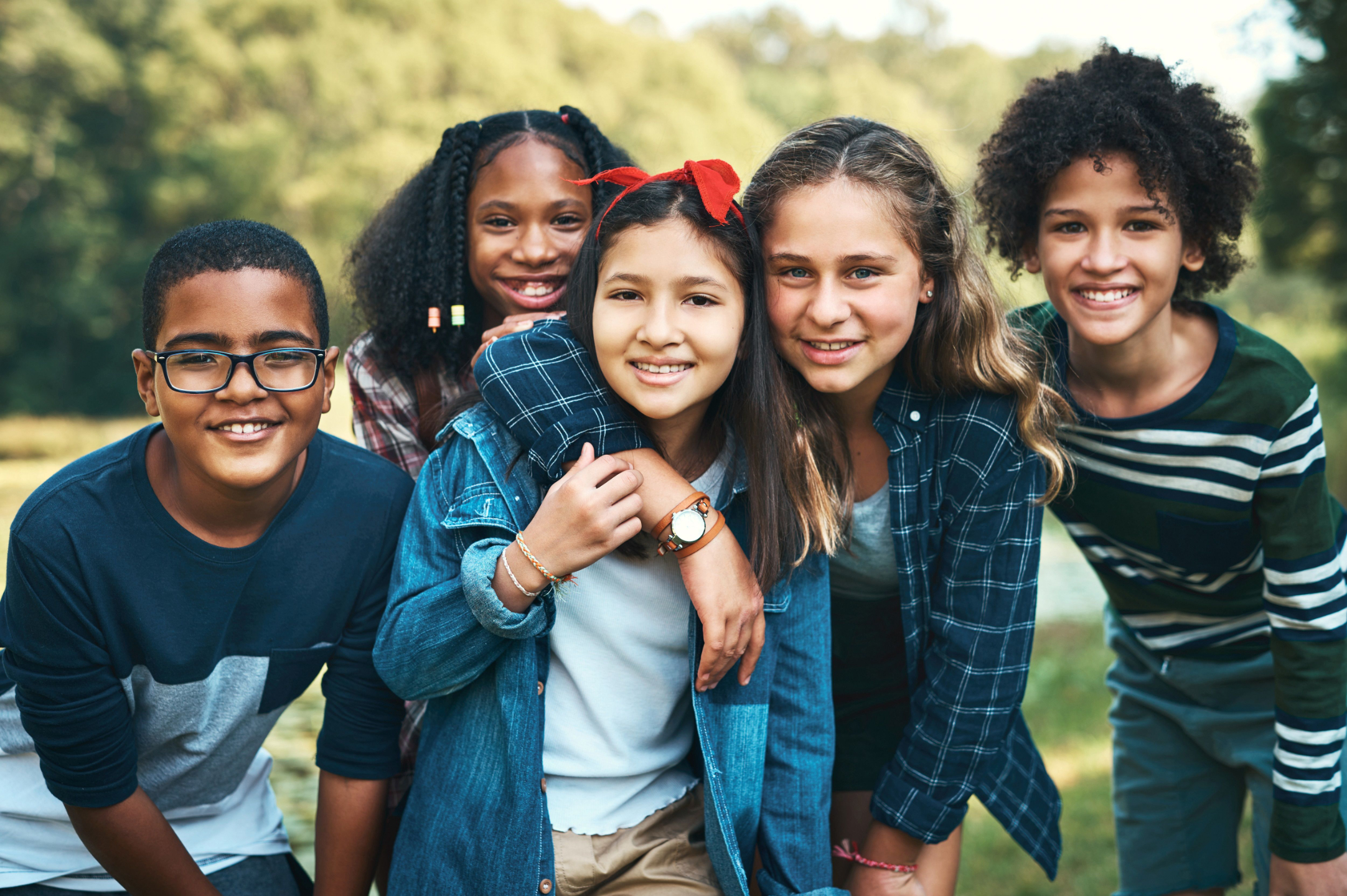
Relationships and Belonging Predict Social and Emotional Growth
A study published in the journal Psychology in the Schools in 2024 gives after-school leaders something worth considering. Amy Fisher and colleagues examined 144 students in grades three through eight across nine elementary and middle school sites in a large youth development program, looking at three things that shape social and emotional growth in the after-school setting: the quality of staff and student relationships, a child's sense of belonging, and how much the child enjoys engaging with the programming. Each of the three, on its own, significantly predicted healthy social and emotional functioning, and together they explained more than any one of them alone. The strongest single predictor was a child's enjoyment of engaging with the program, and close behind were belonging and the relationship a child had with staff.
This matters for your program because it puts evidence behind this week's theme. Trust is not a soft extra that appears once the real work is done. It is built, in large part, on the relationship children have with your staff and the sense that they belong in the room, and those are the very conditions this research links to social and emotional growth. When you protect consistent adults, help children feel they belong, and make the program something they actually enjoy, you are building the trust that carries them through every transition. The study is honest about its limits. It looks at a single program at one point in time and shows association rather than proof of cause, which is a useful reminder to keep observing your own outcomes rather than assuming any single factor will carry the work. Keep building relationships and a sense of belonging. The trust you are after grows out of them.
Source and article
Fisher, A. E., Johnson, L. R., Minnes, S., Miller, E. K., Riccardi, J. S., and Dimitropoulos, A. (2024). Predictors of social emotional learning in after-school programming: The impact of relationships, belonging, and program engagement. Psychology in the Schools. https://onlinelibrary.wiley.com/doi/10.1002/pits.23113
A Question to Carry into the Week
Where in your program is a child bracing for a change? What is the one transition you could hand part of to your staff or your children this week, so that trust is built before the shift arrives rather than tested after it?
With dignity and purpose,
Dr. Toledo
Sonia Toledo, PhD · Founder, Dignity of Children · Author, Beyond Supervision
Join the Safe to Thrive movement HERE
Get your Copy Beyond Supervision
Enroll to Lead with Heart & Mind: 6-Week Guided Transformational Journey HERE
Book Professional Development Workshops for Educators HERE
Book Professional Development Workshops for Leadership HERE
Register for Director's Lab 2.0 - a program for Supervisors and Directors
To discuss your training needs, schedule a one-on-one consultation with me HERE
Dignity of Children
The Weekly Practice · Building quality through discipline, adjustment, and consistency.