DIGNITY OF CHILDREN · DR. TOLEDO
The Weekly Practice
Issue No. 17 Week of October 15h, 2026 Focus: Executive Function
A Message to the Program Director
Somewhere in your community tonight is a young person who made it through this week because you did not give up on them. The patience you spend on the children who need it most is the rarest resource in your program, and it never appears on a budget line. The boy at the art table is one of them: three months in, his paper still blank ten minutes in, the activity declared stupid, three staff members asking him to start, until the moment landed where those moments always land, with you. His blank paper is not your program failing him. It is a message, and learning to read it accurately is the work of this week.
Last week's reset was the precondition for this week's skill. Once the body is settled and the child is settled, the question under most refusal is not motivation. It is a missing skill. When you and your staff can name the specific executive function a behavior is asking for, you stop correcting a child who cannot do what you are asking, and start teaching a child who finally has a name for what is hard. That is the third link of the Belief-to-Outcomes framework: Executive Function. It is also why your own emotional intelligence remains program infrastructure. A director who reads behavior accurately teaches a whole staff to read it accurately.
Your emotional intelligence focus this week: social awareness. The next time a child is settled but stuck, read for the missing skill instead of the missing motivation. Give the need a name before you give a direction.

THIS WEEK'S FOCUS:
Executive Function
Walter Mischel and his colleagues ran the experiment most people know as the marshmallow test, and almost everybody remembers it wrong. In the original studies, children who waited for the bigger reward were not found to have stronger character. They had strategies: they covered their eyes, sang to themselves, turned the tray away, reimagined the marshmallow as a picture rather than a food. Waiting was not a virtue the children possessed. It was an attention skill the children used, and that distinction is everything for how we read behavior. The boy with the blank paper is not short on character. He is short on a strategy for starting.
The more hopeful finding came later. Adele Diamond and Kathleen Lee reviewed the intervention research in 2011 and concluded that executive function skills are teachable in children from four to twelve, and that the interventions that work share a shape: they rehearse the skill inside a routine, with practice and repetition, rather than explaining the skill in a lesson. Executive function is built the way a jump shot is built, in drills, not in lectures. That is why the framework puts it after Nervous System and before Systems: the body has to be settled enough to practice, and the practice has to live in a routine that carries it.
So the diagnostic move of this week is to stop asking what is wrong with this child and start asking which skill is this behavior requesting. Below is a quick pairing of the tells you already see every day with the executive function skill underneath them.

The Quick Diagnostic: The Tell and the Skill Underneath
Before responding to a challenging behavior, pause and look for the skill that may be developing underneath it. What looks like defiance, frustration, or carelessness may be a sign that a young person needs support with an executive function skill.
| The behavior you see | The skill underneath | What may help |
|---|---|---|
| Grabs, snatches, or interrupts | Impulse control: Pausing before acting takes practice. | Practice waiting in small, manageable steps and acknowledge each successful pause. |
| Stares at a blank page or refuses to start | Task initiation: Getting started may feel harder than completing the task. | Make the first step smaller, clearer, and easier to begin. |
| Melts down when plans change | Cognitive flexibility: Shifting from one expectation to another can be difficult. | Preview changes when possible and rehearse alternatives during calm moments. |
| Loses things or misses steps | Working memory: Holding and following multiple pieces of information can be challenging. | Shorten instructions, give one step at a time, and provide a written or visual reminder. |
| Repeats one solution despite growing frustration | Flexible thinking: Generating and trying another approach takes practice. | Model a second option and practice switching strategies when the young person is calm. |
The adult's role is not simply to stop the behavior. It is to identify the skill that may be missing and create opportunities to practice it. Support the skill, preserve the young person's dignity, and build the conditions for success.
Sources and Further Reading
Mischel, W., Ebbesen, E. G., & Zeiss, A. R. (1972). Cognitive and attentional mechanisms in delay of gratification. Journal of Personality and Social Psychology, 21(2), 204–218.
Diamond, A., & Lee, K. (2011). Interventions shown to aid executive function development in children 4 to 12 years old. Science, 333(6045), 959–964.
With dignity and purpose,
Dr. Sonia Toledo
Sonia Toledo, PhD
Founder and CEO, Dignity of Children

One Small Step this Week
At your next team meeting, take the one behavior that eats the most minutes in your week and use the diagnostic table to name the skill underneath it. Then change one part of the environment that rehearses that skill, a visual checklist, a five-minute warning, a smaller first step, and keep it for two weeks before judging it.

SECTION 6 · PARTNER HIGHLIGHT
We Cannot Do This Work Alone
None of us builds a strong program in isolation. The leaders who go the furthest are the ones who surround themselves with partners, resources, and people who strengthen the work. Each week I will introduce a new partner you can add to your own resources, so that over time you build a network you can lean on instead of carrying everything yourself.
This week's partner is MILLU
Okay, we can finally share it… our second MILLU kit is here! 🎉
The Inner Critic Kit: Reframing Negative Thoughts 💚
And yes… pre-orders are officially open! 🎉

BEYOND SUPERVISION: A practical guide for building emotionally safe, inclusive afyerschool programs that support all learners.
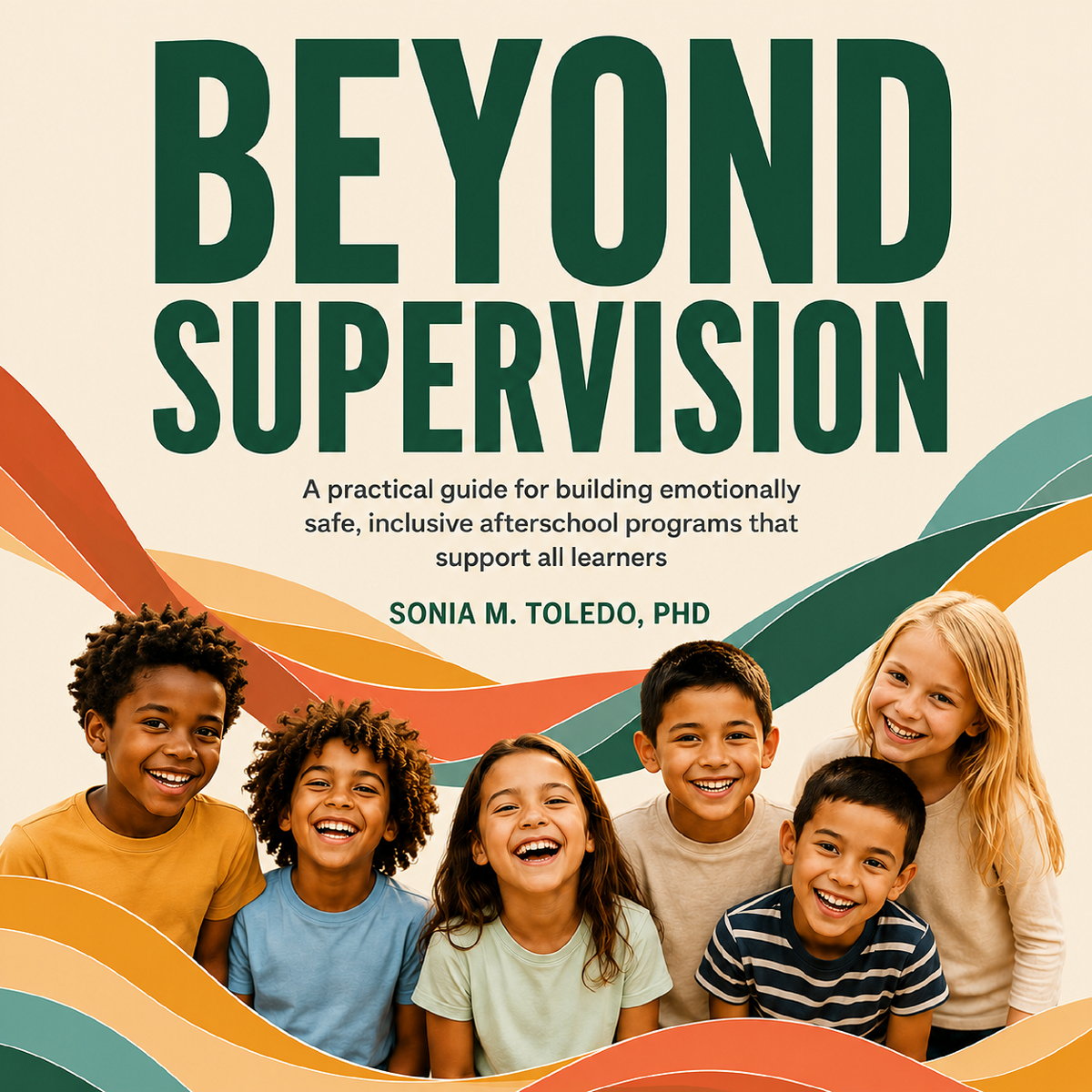
Beyond Supervision maps the executive function skills to the behaviors that request them, week by week.
Get your copy: https://www.amazon.com/dp/B0H66NLP7M
Already read it? A review helps other program leaders find it: https://www.amazon.com/review/create-review?&asin=B0H66NLP7M
P.S. If this issue spoke to you, forward it to one program leader or colleague who needs it. If it was forwarded to you, sign up for The Weekly Practice here: https://www.dignityofchildren.com/
Next week we move to the second link: Nervous System. The story is told in three seconds, but the body answers first, so we will look at what to do in those seconds, in your own body, before you address anyone else's.
A Question to Carry into the Week
Which skill was missing under the last hard behavior I saw?
With dignity and purpose,
Dr. Toledo
Sonia Toledo, PhD · Founder and CEO, Dignity of Children · Author, Beyond Supervision
P.S.
If this issue spoke to the work you are doing, join our Safe To Thrive Community: https://bit.ly/4dSMCJE
If you know one colleague or leader who needs this, forward this issue to them. They can sign up for The Weekly Practice here.
Next Week
Next week we reach the fourth link: Systems. A skill named is not yet a skill built, so we will look at the routine that grows it, step by step.







Join the Safe to Thrive movement HERE
Get your Copy Beyond Supervision
Enroll to Lead with Heart & Mind: 6-Week Guided Transformational Journey HERE
Book Professional Development Workshops for Educators HERE
Book Professional Development Workshops for Leadership HERE
Register for Director's Lab 2.0 - a program for Supervisors and Directors
To discuss your training needs, schedule a one-on-one consultation with me HERE
Dignity of Children
The Weekly Practice · Building quality through discipline, adjustment, and consistency.