DIGNITY OF CHILDREN · DR. TOLEDO
The Weekly Practice
Issue No. 18 Week of October 22nd, 2026 Focus: Systems
A Message to the Program Director
Your community stands on work nobody sees, and you do more of it than anyone. When your newest staff member opened the door Monday at 7:58, to forty children and the chime and the six words about cleanup and the walk to the circle, she was walking on ground you built by being the morning routine yourself, year after year. That invisible labor, carrying the culture in your own body so nothing drops, is one of the most demanding parts of your job, and it is the part that goes unrecorded. So here is the quiet relief: the fact that everything depends on you is not a compliment. It is a design problem, and design can be changed.
That is the fourth link of the Belief-to-Outcomes framework: Systems. When a routine lives on paper, in a schedule, and in the hands of several people, your program stops running on your personal stamina and starts running on its own architecture. A system is also how you care for many people at once, because it makes the warmth repeatable, the same greeting for the child whose mother works nights and the child whose father picks him up early. Your emotional intelligence is the design sense behind those systems, which is why it is program infrastructure: the director who manages relationships well builds routines that hold relationships.
Your emotional intelligence focus this week: relationship management. Before you deliver a correction to a staff member or a child, offer one specific, true piece of appreciation earlier in the day. You are not softening the standard. You are making it possible for the correction to land in a relationship instead of against one.

THIS WEEK'S FOCUS:
Systems
Robert Pianta and Megan Stuhlman found something quietly remarkable about the power of what we build. In their 2004 study of teacher-child relationships, the closeness or conflict a teacher reported with a child in the fall predicted that child's academic adjustment later in the year, and the relationship mattered independently of the child's behavior. Relationships were not a pleasant byproduct of a good program. They were load-bearing, measurable infrastructure, doing work that no lesson plan could do.
Joseph Durlak and his colleagues found the same truth at the level of the whole school. Their 2011 meta-analysis reviewed 213 school-based programs reaching about 270,000 students, and the programs that changed behavior and achievement were not the ones with the best single lesson. They were the ones that embedded the skills into the school's routines and practices so that every adult, every transition, and every interaction carried them. Culture built into systems produced outcomes. Culture left to individual heroics did not.
That is why the fourth link exists between Executive Function and Outcomes. A skill that has been named and taught still needs a routine that rehearses it daily, or it fades by Friday. Below is the transition routine from Beyond Supervision, walked through as a mini case, so you can install one system this week.

One system from the book, step by step: the four-part transition
The situation: every afternoon at cleanup, two staff members yell over the noise, children scatter, and the first five minutes of the circle are spent recovering.
1. The signal. Choose one chime, the same one every day, and let nothing else serve as the signal. The nervous system learns what is predictable.
2. Name the ending. The same six words every day: two more minutes, then we clean up. The child who melts down when plans change is getting a rehearsal of that exact skill.
3. Name what is coming. After cleanup, we sit in the circle. The brain can move toward what it can picture.
4. Move together. The staff moves first, walking the room with the children rather than directing from the doorway. Regulation travels with the adults.
The before-and-after: in the programs I work with, the yelling stops within a week, and the circle starts on time within two. The routine works because it is a system, and it keeps working when the person who taught it goes on vacation.
Source and reading: Pianta, R. C., & Stuhlman, M. W. (2004). Teacher-child relationships and children's early academic adjustment. Journal of School Psychology, 42(3), 189-212. Durlak, J. A., Weissberg, R. P., Dymnicki, A. B., Taylor, R. D., & Schellinger, K. B. (2011). The impact of enhancing students' social and emotional learning: A meta-analysis of school-based universal interventions. Child Development, 82(1), 405-432.
With dignity and purpose,
Dr. Toledo
Sonia Toledo, PhD
Founder and CEO, Dignity of Children
Author, Beyond Supervision
One Small Step this Week
Choose the most chaotic ten minutes of your program day and run the four-step transition for one week with the same words every time. Write the four steps on a card and hand it to two staff members, so the routine lives on paper instead of in one person's memory.
SECTION 6 · PARTNER HIGHLIGHT
We Cannot Do This Work Alone
None of us builds a strong program in isolation. The leaders who go the furthest are the ones who surround themselves with partners, resources, and people who strengthen the work. Each week I will introduce a new partner you can add to your own resources, so that over time you build a network you can lean on instead of carrying everything yourself.
This week's partner is The Guardian Project
What kind of world will our children and grandchildren inherit? And what can we do today to help shape it?
These questions are at the heart of The Guardian Project, and we are excited to invite you to explore our new website.
We are building a movement that turns promises to children into everyday acts of service, care, and courage. Whether you are an educator, parent, grandparent, student, or community leader, there is a place for you.
We are also forming a Board and an Advisory Committee to help shape The Guardian Project’s next chapter. These groups will bring together diverse perspectives, experience, and a shared commitment to serving future generations. Together, they will guide the movement, strengthen connections, and inspire meaningful action in communities worldwide.
Joining the movement is free. Bring your ideas, your heart, and your commitment to serving the future.
EXPLORE THE WEBSITE & JOIN THE MOVEMENT
Please share this invitation with someone who cares about the future our children will inherit
Serve the Future. Keep the Promises. Become a Good Ancestor.
Best regards,
Robert Landau
Founder & Co-Director
Aaron Moniz and Lauren Jones
Co-Directors
BEYOND SUPERVISION: A practical guide for building emotionally safe, inclusive afyerschool programs that support all learners.
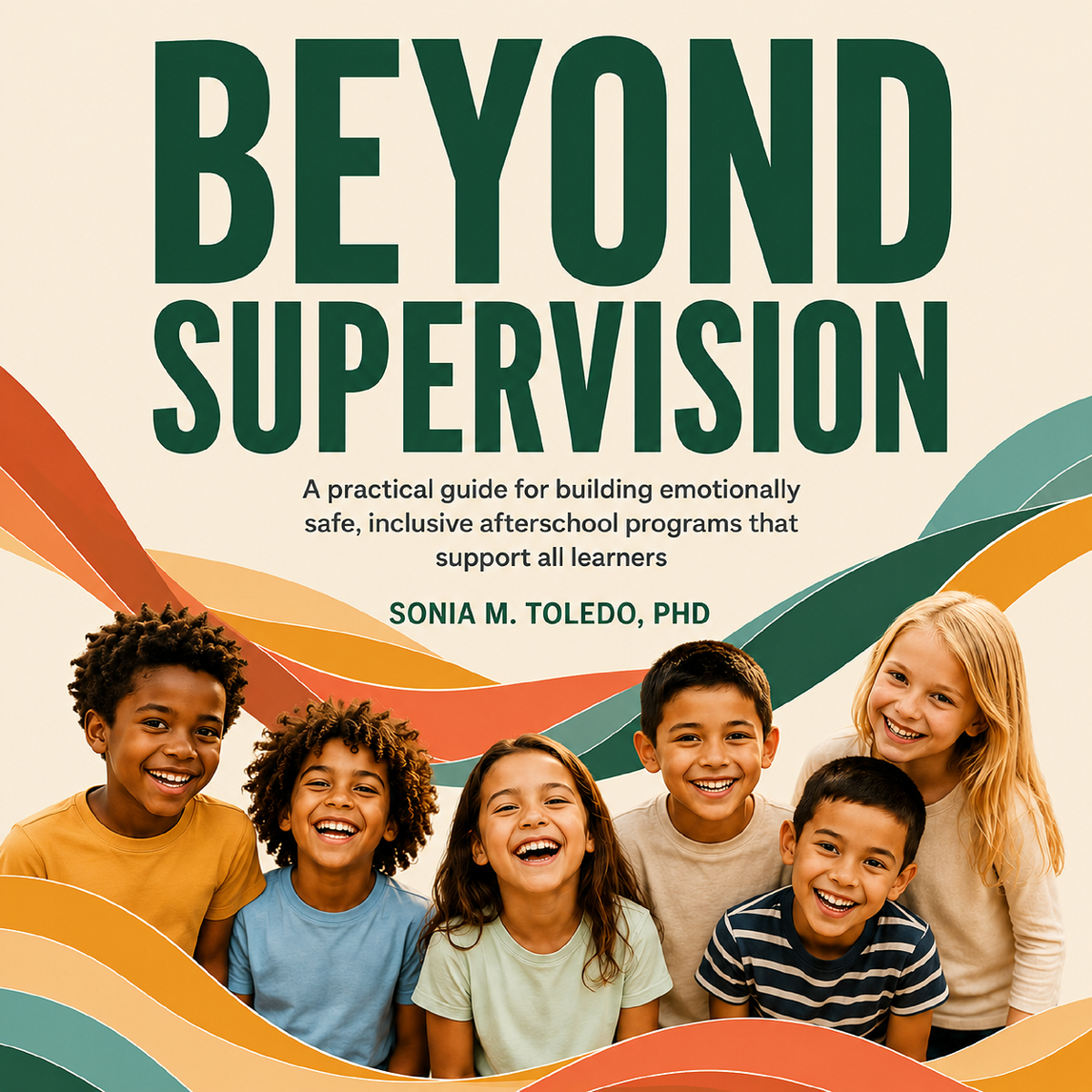
The systems chapter of Beyond Supervision walks through the routines, like the four-part transition, that make culture repeatable.
Get your copy: https://www.amazon.com/dp/B0H66NLP7M
Already read it? A review helps other program leaders find it: https://www.amazon.com/review/create-review?&asin=B0H66NLP7M
P.S. If this issue spoke to you, forward it to one program leader or colleague who needs it. If it was forwarded to you, sign up for The Weekly Practice here: https://www.dignityofchildren.com/
Next week we move to the second link: Nervous System. The story is told in three seconds, but the body answers first, so we will look at what to do in those seconds, in your own body, before you address anyone else's.
A Question to Carry into the Week
Who on my team heard something specific and true from me today?
With dignity and purpose,
Dr. Toledo
Sonia Toledo, PhD · Founder and CEO, Dignity of Children · Author, Beyond Supervision
P.S.
This newsletter gives you one link per week. The whole framework, with room to practice it alongside other program leaders, lives here: https://bit.ly/4dSMCJE
If you know one colleague or leader who needs this, forward this issue to them. They can sign up for The Weekly Practice here.
Next Week
Next week we reach the fifth link: Outcomes. A system installed still needs to be read, so we will look at what your program is producing and how to feed it back into the next cycle.




Join the Safe to Thrive movement HERE
Get your Copy Beyond Supervision
Enroll to Lead with Heart & Mind: 6-Week Guided Transformational Journey HERE
Book Professional Development Workshops for Educators HERE
Book Professional Development Workshops for Leadership HERE
Register for Director's Lab 2.0 - a program for Supervisors and Directors
To discuss your training needs, schedule a one-on-one consultation with me HERE
Dignity of Children
The Weekly Practice · Building quality through discipline, adjustment, and consistency.