DIGNITY OF CHILDREN · DR. TOLEDO
The Weekly Practice
Issue No. 19 Week of October 29th, 2026 Focus: Outcomes
A Message to the Program Director
The difference you are making in your community will never fully fit into a report, and the parts that matter most are the ones nobody counts. Let this issue be the place that names them. Friday afternoon, the gym stayed quiet through the transition that used to eat ten minutes of your day, and the only witness was you. You carry outcomes in both directions, the numbers that go to funders and boards, and the quieter evidence that accumulates in the memory of whoever stands in the doorway each day. A data point that comes in low is not a verdict on your worth or your program's. It is one reading from an instrument, and instruments can be read well or badly.
The fifth link of the Belief-to-Outcomes framework is Outcomes, and its real job is feedback. A program that reads what it is producing can adjust the next cycle: the belief, the regulation, the skills, the systems. A program that only reports what it produces is driving with the windshield painted over. You are the one who builds that feedback loop, and your emotional intelligence decides whether the loop encourages people or flattens them, because a director who can locate progress is the reason a staff keeps believing the work is going somewhere.
Your emotional intelligence focus this week: motivation and self-agency. At the end of each day, name one thing that went better and trace it to a practice you or your team built. Then tell one person what you saw. You are training yourself to locate progress, because a leader who can find it can grow it.

THIS WEEK'S FOCUS:
Outcomes
Albert Bandura spent his career on a single question: what makes people keep trying? His 1977 paper on self-efficacy proposed that effort and persistence come from a person's belief in their own capability, and the strongest source of that belief is not encouragement but mastery, the lived experience of watching yourself succeed at something hard. That finding has a direct design consequence for your program. Progress that nobody notices does not build anyone's belief, in a child or in a staff member. Outcomes have to be seen and attributed, or they cannot do their work as fuel.
Edward Deci and Richard Ryan added the caution that goes with it. Their 2000 paper on self-determination described three needs that fuel motivation from inside: autonomy, competence, and relatedness. When outcomes arrive as surveillance, scores posted to rank people, the motivation drains out even when the numbers improve. When the people who produce the outcomes are the ones who read them and interpret them, the numbers feed agency instead. The difference is not the data. It is who gets to hold it.
So the fifth link is not about collecting more data. It is about closing the loop with the people inside it. Below is a one-week tracker that keeps the reading light and the attribution honest.

A One-Week Outcomes Tracker
|
Day |
One hard moment and the skill it required |
One thing that went better and what helped make it happen |
One thing I want more of next week |
|---|---|---|---|
|
Monday |
|||
|
Tuesday |
|||
|
Wednesday |
|||
|
Thursday |
|||
|
Friday |
Sources and Further Reading
Bandura, A. (1977). Self-efficacy: Toward a unifying theory of behavioral change. Psychological Review, 84(2), 191–215.
Deci, E. L., & Ryan, R. M. (2000). The “what” and “why” of goal pursuits: Human needs and the self-determination of behavior. Psychological Inquiry, 11(4), 227–268.
With dignity and purpose,
Dr. Toledo
Sonia Toledo, PhD
Founder and CEO, Dignity of Children
Author, Beyond Supervision

One Small Step this Week
Pick one number your program already collects, attendance, incidents, or participation, and post it once this week where the whole team can see it. Spend five minutes of the Friday huddle letting staff say what they think produced it. The reading belongs to the people who made it.
SECTION 6 · PARTNER HIGHLIGHT
We Cannot Do This Work Alone
As we focus on building intentional systems this week to protect your time and energy, we are thrilled to feature our partner, AfterSchool HQ.
When administrative workflows rely entirely on manual effort, they rapidly drain the team energy your program depends on. If your staff is still tracking attendance by hand, chasing down physical registration forms, or managing payment collections, you are fixing operational design problems with your limited personal time. AfterSchool HQ is a purpose-built youth organization management platform designed to replace these exhausting, paper-heavy tasks with automated software systems.
Their platform supports your program's day-to-day operations through three automated pillars:
- Online Registrations and Payments: Families can easily discover activities, complete forms, and submit payments through a seamless digital portal, removing manual front-desk friction.
- Centralized Student Tracking: Staff gain immediate access to vital student records, automated waiting lists, and digital check-in/check-out tools to keep everyone aligned.
- Real-Time Impact Reports: The software simplifies data collection, centralizing both quantitative and qualitative metrics automatically so you can present clear results to funders without sacrificing hours of direct service time.
For programs that want a truly effortless transition, their Autopilot Implementation Service allows your organization to hand off the entire technical setup, data migration, and enrollment configuration to a dedicated support team.
Beyond their management software, AfterSchool HQ has intentionally built a highly engaged ecosystem for afterschool professionals. They host their dedicated network on Circle, a premier platform for modern interactive groups. Exploring their platform provides a firsthand look at how a masterfully organized community space can cultivate deep provider engagement, encourage continuous learning, and foster peer-to-peer resource sharing.
You can experience this network yourself and access their exclusive tools, forums, and ongoing support networks by visiting the official page to explore and join the AfterSchool HQ Membership.
BEYOND SUPERVISION: A practical guide for building emotionally safe, inclusive afyerschool programs that support all learners.
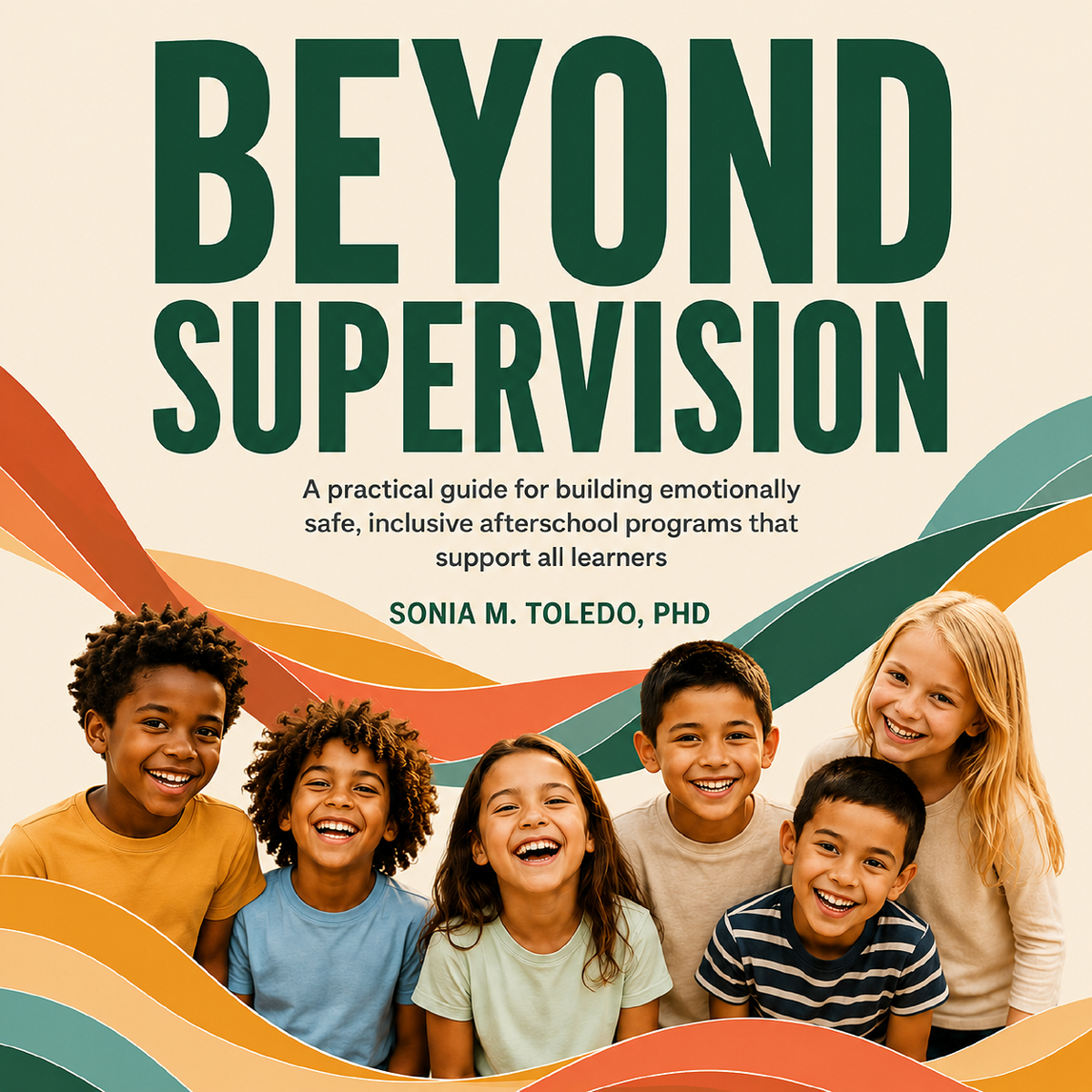
Beyond Supervision closes the loop, connecting the outcomes you are already producing back to the beliefs and systems that create them.
Get your copy: https://www.amazon.com/dp/B0H66NLP7M
Already read it? A review helps other program leaders find it: https://www.amazon.com/review/create-review?&asin=B0H66NLP7M
P.S. If this issue spoke to you, forward it to one program leader or colleague who needs it. If it was forwarded to you, sign up for The Weekly Practice here: https://www.dignityofchildren.com/
Next week we move to the second link: Nervous System. The story is told in three seconds, but the body answers first, so we will look at what to do in those seconds, in your own body, before you address anyone else's.
A Question to Carry into the Week
What went better this week because of something we built?
With dignity and purpose,
Dr. Toledo
Sonia Toledo, PhD · Founder and CEO, Dignity of Children · Author, Beyond Supervision
P.S.
This newsletter gives you one link per week. The whole framework, with room to practice it alongside other program leaders, lives here: https://bit.ly/4dSMCJE
If you know one colleague or leader who needs this, forward this issue to them. They can sign up for The Weekly Practice here.
Next Week
Next week we reach the fifth link: Outcomes. A system installed still needs to be read, so we will look at what your program is producing and how to feed it back into the next cycle.



Join the Safe to Thrive movement HERE
Get your Copy Beyond Supervision
Enroll to Lead with Heart & Mind: 6-Week Guided Transformational Journey HERE
Book Professional Development Workshops for Educators HERE
Book Professional Development Workshops for Leadership HERE
Register for Director's Lab 2.0 - a program for Supervisors and Directors
To discuss your training needs, schedule a one-on-one consultation with me HERE
Dignity of Children
The Weekly Practice · Building quality through discipline, adjustment, and consistency.