DIGNITY OF CHILDREN · DR. TOLEDO
The Weekly Practice
Issue No. 12 Week of September 10th, 2026 Focus: Systems
A Message to the Program Director
Last week you practiced asking what the child is trying to do, not what they are trying to avoid. That question changes how you see the moment, but it does not, by itself, change the child’s next moment. What changes the next moment is a routine that gives the child a place to practice the skill you identified. Building that routine is slower work than correcting a behavior, and it asks you to hold the long view while the short view is pulling at you all day.
The slowness of that work is not a sign that you are doing it wrong. It is the pace at which systems grow. The Belief-to-Outcomes framework puts systems at this link because identifying a missing skill is only the beginning. The question now is how to build a routine that grows that skill instead of correcting it in the hard moment, and that work is where your program becomes more than a series of reactions. This is why your emotional intelligence is program infrastructure, not an accessory to the real work. A director who manages relationships with intention gives staff the safety to try a new approach with a child, and staff who feel supported will build the routine; staff who feel judged will fall back on what they already know.
Your emotional intelligence focus this week: relationship management. Choose one staff member who is struggling with a child’s behavior and spend ten minutes this week listening to what they have already tried. You are not fixing the situation for them. You are building the relationship that makes it possible for them to try something new, because staff try new things for leaders who have heard them first.

THIS WEEK'S FOCUS:
Systems
How do I build a routine that grows that skill, instead of correcting it in the hard moment?
You have identified the skill the child is missing. Now the framework asks you to build the routine that teaches it. This is the Systems link, and it is where the Belief-to-Outcomes framework moves from seeing to building. A routine is not a rule. A rule tells a child what not to do. A routine gives a child a structured place to practice what they are learning to do, and it does so before the hard moment arrives, not in the middle of it.
Catherine Bradshaw and her colleagues showed what happens when a school builds a system around behavior rather than reacting to it incident by incident. In a four-year randomized controlled trial across 37 elementary schools with over 12,000 children, they implemented School-Wide Positive Behavioral Interventions and Supports, a framework that trains staff to establish clear expectations, teach them explicitly, and reinforce them consistently across all settings (Bradshaw, Waasdorp, & Leaf, 2012). Children in the intervention schools showed significant reductions in behavior problems and concentration problems, significant improvements in social-emotional functioning and prosocial behavior, and were 33% less likely to be referred to the office for discipline. The system worked not because it punished behavior more efficiently but because it taught the skills the children were missing before the behavior became a problem.
But a system is only as strong as the relationships inside it. Debora Roorda and colleagues conducted a meta-analysis of the affective quality of teacher-student relationships and their impact on engagement and achievement (Roorda, Koomen, Spilt, & Oort, 2011). They found medium to large associations between positive relationships and student engagement, and significant associations with achievement. Negative, conflict-heavy relationships predicted lower engagement and lower achievement. The system the director builds is the structure; the relationship the staff member brings to it is the substance. Without the relationship, the routine becomes another rule. With it, the routine becomes a practice the child can trust.
This is the Systems link in the Belief-to-Outcomes framework. The belief you hold tells you what to look for. Your regulated body tells the child they are safe. The skill you identified tells you what to teach. The system you build gives the child a place to practice until the skill becomes theirs. When you replace correction with routine, you stop asking children to perform what they have not been taught and start giving them the repetitions that build the skill into who they are.

A REFRAME TOOL FOR THE WEEK
A Mini Case: Building a Transition Routine
Here is how a director might build one system, step by step, to teach a specific skill.
Step 1: Name the skill. In last week’s diagnostic, you noticed that a child melts down every time the group moves from free play to cleanup. The skill missing is cognitive flexibility: the ability to shift from one plan to another.
Step 2: Build the scaffold. Instead of correcting the meltdown when it happens, you design a two-minute warning routine. A staff member holds up a visual card showing a transition arrow, says the child’s name, and narrates what is coming: “In two minutes, we move to cleanup. You can bring one toy to the shelf before we start.” The visual card gives the child’s brain a signal that change is coming. The narration gives the child’s working memory something to hold. The choice gives the child’s autonomy a place to land.
Step 3: Practice before the moment. Run the transition routine three times when things are calm: once during morning circle, once after snack, once before outdoor time. The child practices shifting when the stakes are low, not when the room is loud and the schedule is tight.
Step 4: Read what the routine produces. After one week, notice what changed. Did the meltdowns shorten? Did the child begin to look for the card? Did the staff member use the routine consistently or abandon it by Wednesday? Feed what you observe back into the next iteration.
Source and reading
Bradshaw, C. P., Waasdorp, T. E., & Leaf, P. J. (2012). Effects of school-wide positive behavioral interventions and supports on child behavior problems. Pediatrics, 130(5), e1136-e1145. https://doi.org/10.1542/peds.2012-0243
Roorda, D. L., Koomen, H.M.Y., Spilt, J.L.F., & Oort, F.J. (2011). The influence of affective teacher-student relationships on students’ school engagement and achievement: A meta-analytic approach. Review of Educational Research, 81(4), 493-529. https://doi.org/10.3102/0034654311421793
One Small Step this Week
Pick one behavior from last week’s diagnostic table and build one routine around it before Friday. Write the routine on an index card: the skill it targets, the signal that starts it, and the one thing the staff member says. Hand it to the staff member who works with that child and ask them to try it for five days. You are not redesigning your whole program. You are building one small system and seeing what it produces.
SECTION 6 · PARTNER HIGHLIGHT
We Cannot Do This Work Alone
None of us builds a strong program in isolation. The leaders who go the furthest are the ones who surround themselves with partners, resources, and people who strengthen the work. Each week we will introduce a new partner you can add to your own resources, so that over time you build a network you can lean on instead of carrying everything yourself.
This week's partner is Two by Two Character Development.
Two by Two Character Development is a nonprofit organization that equips schools and youth-serving organizations with engaging, hands-on character education and social-emotional learning experiences. Through rescue-inspired stuffed cats and dogs, interactive lessons, and professional learning, Two by Two helps children build empathy, responsibility, kindness, and the relationship skills they need to thrive.
Core Focus Areas
- Building empathy, kindness, and compassion
- Strengthening social-emotional and character development
- Developing responsibility and positive decision-making
- Creating caring, connected school and youth communities
Signature Programs
- Kindhearted Kids® – Rescue-inspired stuffed cats and dogs that help children practice empathy, responsibility, and life skills through memorable, hands-on experiences.
- Kindhearted Kids® – Meet the Challenge – A collaborative, station-based character education experience where students work together to solve challenges while building teamwork, empathy, perseverance, responsibility, and problem-solving skills.
- Character Connections® – Flexible classroom and small-group resources that reinforce character, social-emotional learning, and relationship-building throughout the school year.
- Professional Learning – Interactive workshops that provide educators and youth professionals with practical strategies to strengthen school culture, student engagement, and belonging.
Impact
- More than 20 years of empowering children through character education.
- Partnering with schools, afterschool programs, counselors, and youth organizations across 40+ states.
- Research-informed programs designed to help children develop the skills they need for success in school, relationships, and life.
Discover educational materials via the official Two by Two Store
Read the full Belief-to-Outcomes framework in Beyond Supervision by Sonia Toledo, PhD.
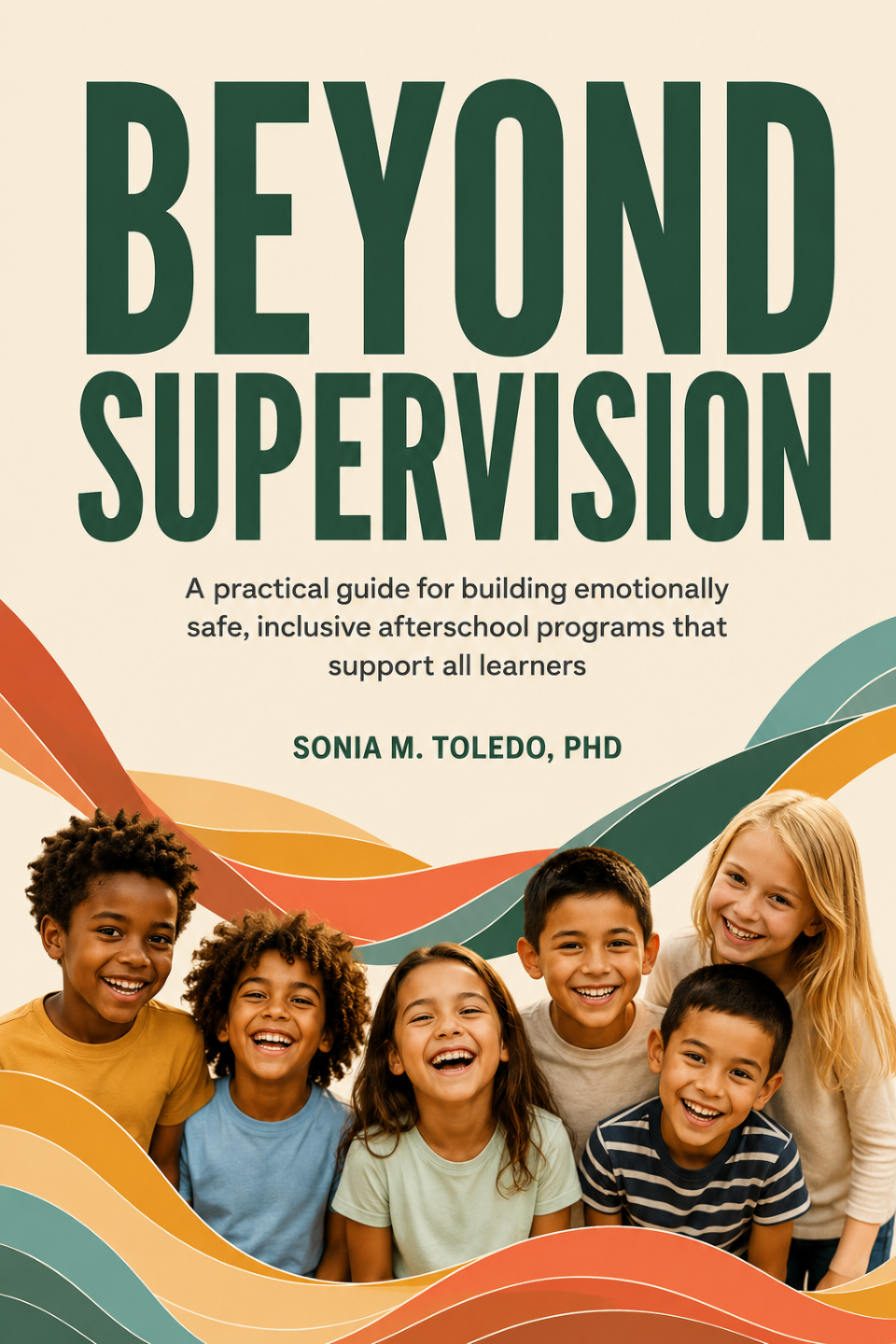
Beyond Supervision walks through all five links of the From Belief to Outcomes framework: Belief, Nervous System, Executive Function, Systems, and Outcomes. Buy the book here. If it has helped your practice, leave a review here.
A Question to Carry into the Week
What happened the last time a staff member felt heard before they tried something new?
With dignity and purpose,
Dr. Toledo
Sonia Toledo, PhD · Founder and CEO, Dignity of Children · Author, Beyond Supervision
P.S.
If this issue spoke to the work you are doing, join our Safe To Thrive Community: https://bit.ly/4g2tM4y
If you know one colleague or leader who needs this, forward this issue to them. They can sign up for The Weekly Practice https://www.dignityofchildren.com/
Next Week
Next week we move to the Outcomes link of the Belief-to-Outcomes framework: How do I read what the system is producing, and feed it back to refine the next cycle?



Join the Safe to Thrive movement HERE
Get your Copy Beyond Supervision
Enroll to Lead with Heart & Mind: 6-Week Guided Transformational Journey HERE
Book Professional Development Workshops for Educators HERE
Book Professional Development Workshops for Leadership HERE
Register for Director's Lab 2.0 - a program for Supervisors and Directors
To discuss your training needs, schedule a one-on-one consultation with me HERE
Dignity of Children
The Weekly Practice · Building quality through discipline, adjustment, and consistency.