DIGNITY OF CHILDREN · DR. TOLEDO
The Weekly Practice
Issue No. 13 Week of September 17th, 2026 Focus: Outcomes
A Message to the Program Director
Your program counts everything: attendance, incidents, staff hours, family contacts. The numbers fill reports that leave your desk and rarely come back as anything you can use. The distance between the data you collect for compliance and the data that would actually help you build is not a failure of your attention. It is a gap in what the system asks you to measure.
Last week you built one routine and handed it to a staff member. Now the question is what to look for when the routine has been running for a week. The Outcomes link is where the Belief-to-Outcomes framework closes: you read what your system is producing and feed it back into the next cycle, not as a judgment but as information that tells you what to adjust. This is why your emotional intelligence is program infrastructure, not an optional practice. A director who can read outcomes without turning them into blame gives the whole program permission to keep learning. One who reads them as verdicts shuts that down before it starts.
Your emotional intelligence focus this week: motivation and self-agency. Before you read what the system produced, notice what you are looking for: evidence that it worked or evidence that it did not. The lens you bring to the data decides what the data tells you, and a director who looks for what is moving, even partially, feeds the next cycle with something the staff can build on.

THIS WEEK'S FOCUS:
Outcomes
How do I read what the system is producing, and feed it back to refine the next cycle?
You built a routine. It has been running for a week. Now you need to read what it produced, and that act of reading is more difficult than it sounds. The temptation is to look for a binary: did it work or didn’t it. But outcomes are rarely binary, and a routine that produced a 10% improvement in a child’s transitions is not a failure. It is information. The Outcomes link asks you to read the system’s output as feedback, not as a verdict, and to feed that feedback back into the next iteration.
Sara Madeleine Kristensen and her colleagues demonstrated why this matters. In a 2023 longitudinal study, they tracked the relationship between academic self-efficacy, academic initiative, and grade point average in Norwegian students over multiple years. They found a positive feedback loop: higher self-efficacy predicted greater initiative, which predicted higher GPA, which in turn reinforced self-efficacy (Kristensen, Danielsen, Urke, Larsen, & Aanes, 2023). The loop was self-reinforcing. When students saw that their effort produced results, their belief in their own capacity grew, and that belief drove the next cycle of effort. The mechanism is the one the Belief-to-Outcomes framework is built on: when a child sees that the system you built is producing something, their agency grows, and that agency drives the next cycle.
The case for building self-agency on purpose is strong. Michael Wehmeyer and his colleagues conducted a randomized controlled trial with 371 high school students receiving special education services, testing whether explicit instruction in self-determination skills, including goal setting, decision making, and self-advocacy, would increase students’ self-determination over three years (Wehmeyer, Palmer, Shogren, Williams-Diehm, & Soukup, 2013). Students in the intervention group showed significantly greater growth in self-determination than those in the control group. Self-determination was not something the children either had or didn’t have. It was a set of skills that could be taught, and teaching them changed what the students believed they could do. Research has linked self-determination to better academic outcomes, more positive employment, and higher quality of life after school.
This is the Outcomes link in the Belief-to-Outcomes framework. The belief you held told you what to look for. Your settled body told the child they were safe. The skill you named told you what to teach. The routine you built gave the child a place to practice. Now the outcome tells you what to keep and what to change. The cycle begins again at Belief, sharper for what this pass taught you.

A REFRAME TOOL FOR THE WEEK
A Mini Case: Building a Transition Routine
Keep this tracker for five days. Do not add columns. Do not make it a spreadsheet. A notepad is enough.
Day 1: What is one thing the system produced today that surprised you? Write it down even if it is small.
Day 2: What did the child do today that they could not do a week ago?
Day 3: What did the staff member do differently today?
Day 4: What did not work? What got in the way?
Day 5: Read what you wrote. What will you adjust next week?
Source and reading
Kristensen, S. M., Danielsen, A. G., Urke, H. B., Larsen, T. B., & Aanes, M. M. (2023). The positive feedback loop between academic self-efficacy, academic initiative, and grade point average: A parallel process latent growth curve model. Educational Psychology, 43(7), 835-853. https://doi.org/10.1080/01443410.2023.2242603
Wehmeyer, M. L., Palmer, S. B., Shogren, K., Williams-Diehm, K., & Soukup, J. (2013). Establishing a causal relationship between interventions to promote self-determination and enhanced student self-determination. The Journal of Special Education, 46(4), 195-210. https://doi.org/10.1177/0022466910392377

One Small Step this Week
Keep the observation tracker for five days. At the end of the week, sit with one staff member and share one thing you noticed that you would not have seen without the tracker. You are not evaluating the program. You are practicing the habit of reading what your system produces before you decide what to change.
SECTION 6 · PARTNER HIGHLIGHT
We Cannot Do This Work Alone
As we focus on building intentional systems this week to protect your time and energy, we are thrilled to feature our partner, AfterSchool HQ.
When administrative workflows rely entirely on manual effort, they rapidly drain the team energy your program depends on. If your staff is still tracking attendance by hand, chasing down physical registration forms, or managing payment collections, you are fixing operational design problems with your limited personal time. AfterSchool HQ is a purpose-built youth organization management platform designed to replace these exhausting, paper-heavy tasks with automated software systems.
Their platform supports your program's day-to-day operations through three automated pillars:
- Online Registrations and Payments: Families can easily discover activities, complete forms, and submit payments through a seamless digital portal, removing manual front-desk friction.
- Centralized Student Tracking: Staff gain immediate access to vital student records, automated waiting lists, and digital check-in/check-out tools to keep everyone aligned.
- Real-Time Impact Reports: The software simplifies data collection, centralizing both quantitative and qualitative metrics automatically so you can present clear results to funders without sacrificing hours of direct service time.
For programs that want a truly effortless transition, their Autopilot Implementation Service allows your organization to hand off the entire technical setup, data migration, and enrollment configuration to a dedicated support team.
Beyond their management software, AfterSchool HQ has intentionally built a highly engaged ecosystem for afterschool professionals. They host their dedicated network on Circle, a premier platform for modern interactive groups. Exploring their platform provides a firsthand look at how a masterfully organized community space can cultivate deep provider engagement, encourage continuous learning, and foster peer-to-peer resource sharing.
You can experience this network yourself and access their exclusive tools, forums, and ongoing support networks by visiting the official page to explore and join the AfterSchool HQ Membership.
Read the full Belief-to-Outcomes framework in Beyond Supervision by Sonia Toledo, PhD.
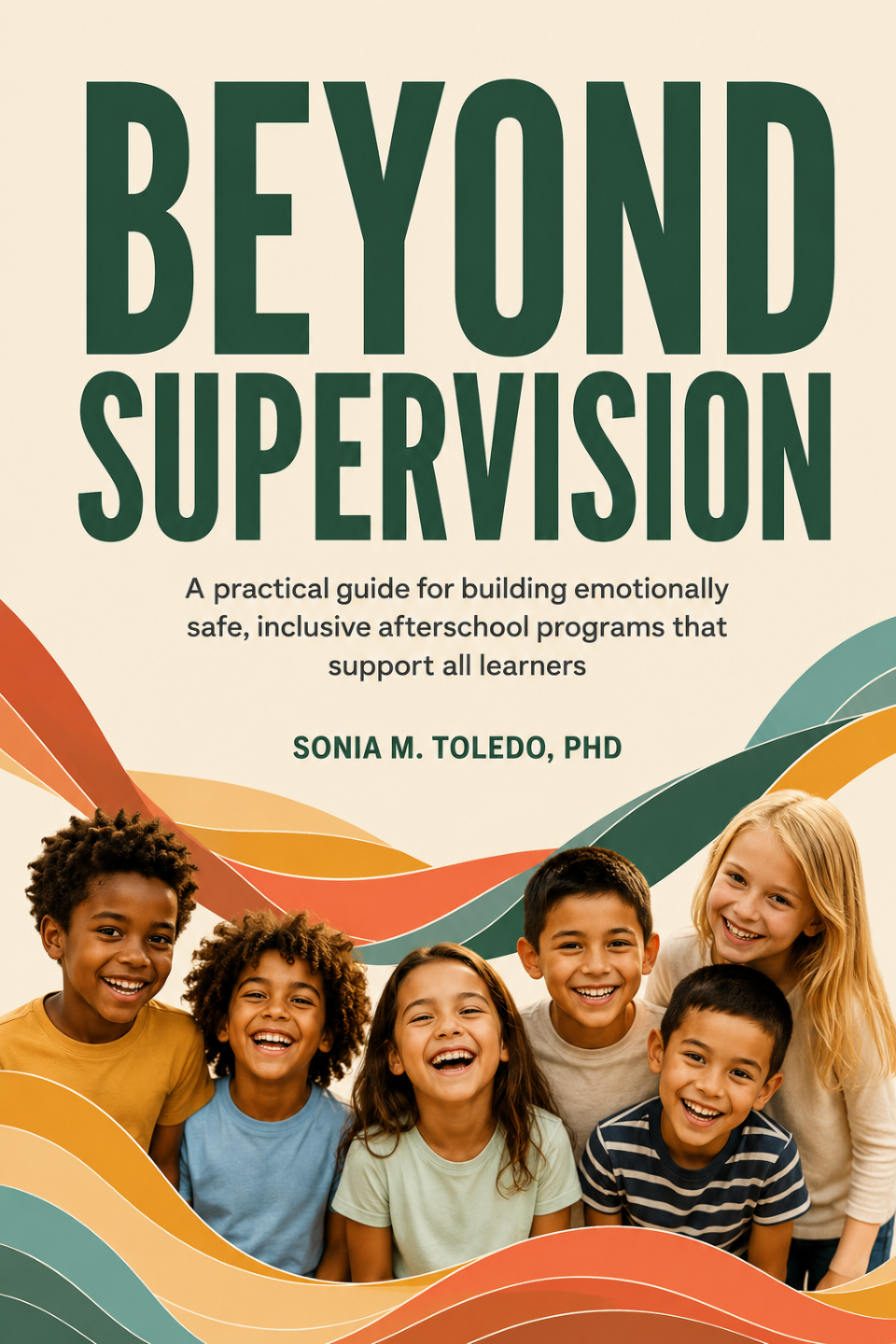
Beyond Supervision walks through all five links of the From Belief to Outcomes framework: Belief, Nervous System, Executive Function, Systems, and Outcomes. Buy the book here. If it has helped your practice, leave a review here.
A Question to Carry into the Week
What did you see this week that you would have missed without looking?
With dignity and purpose,
Dr. Toledo
Sonia Toledo, PhD · Founder and CEO, Dignity of Children · Author, Beyond Supervision
P.S.
If this issue spoke to the work you are doing, join our Safe To Thrive Community: https://bit.ly/4g2tM4y
If you know one colleague or leader who needs this, forward this issue to them. They can sign up for The Weekly Practice https://www.dignityofchildren.com/
Next Week
Next week we step back to look at the full Belief-to-Outcomes framework: what the first pass through all five links has taught you, and where to adjust before the cycle begins again.



Join the Safe to Thrive movement HERE
Get your Copy Beyond Supervision
Enroll to Lead with Heart & Mind: 6-Week Guided Transformational Journey HERE
Book Professional Development Workshops for Educators HERE
Book Professional Development Workshops for Leadership HERE
Register for Director's Lab 2.0 - a program for Supervisors and Directors
To discuss your training needs, schedule a one-on-one consultation with me HERE
Dignity of Children
The Weekly Practice · Building quality through discipline, adjustment, and consistency.