DIGNITY OF CHILDREN · DR. TOLEDO
The Weekly Practice
Issue No. 11 Week of September 1st, 2026 Focus: Belief
A Message to the Program Director
You are holding a program together with attention that never fully divides and never fully rests. The coverage gaps, the compliance deadlines, the family conversations at the door, the staff member who is still becoming who they are while holding space for someone else’s child: all of it sits with you, and you keep choosing the children at the center of it. None of that weight is a judgment on how well you are doing this. It is simply what the work weighs.
The culture in your program will not come from a new curriculum or a tighter discipline policy. It will come from what you and your staff believe is actually happening when a child acts out, because that belief decides the response, and the response decides the room. When a staff member reads a child’s behavior as defiance, they reach for a correction. When they read it as a request to learn, they reach for a relationship. That shift in what you believe is your most dependable influence, and it is the one you can act on today. This is also why your own emotional intelligence is program infrastructure, not a personal wellness matter. A director who can see their own first reaction clearly makes better decisions under pressure, holds staff accountable without escalating them, and gives an entire room a nervous system to borrow.
Your emotional intelligence focus this week: self-awareness. Before you respond to the next behavior that catches you, notice the story your mind has already written in the first three seconds. You do not need to change it yet. You are simply naming what you assumed about the child and the moment, because the belief you hold in the gap between seeing and responding decides what you build next.
THIS WEEK'S FOCUS:
Belief
What story do I tell in the first three seconds, and how does it decide what I build next?
A child throws a chair. Or a child goes silent and will not look up. Or a child pushes past a staff member toward the bathroom. In the first three seconds, before any framework comes to mind, your brain writes a story about what just happened. It is fast, it is automatic, and it is almost always incomplete. The question is not whether you have a story, because you always do. The question is whether you can see it. That story is the first link in the Belief-to-Outcomes chain, and every link after it, from the response you choose to the system you build to the outcome you measure, rests on the foundation of that first three-second interpretation.
Robert Rosenthal and Lenore Jacobson demonstrated this mechanism in 1968 at a California elementary school. They administered an IQ test to all students, then randomly selected 20% and told teachers these children were “intellectual bloomers” poised for dramatic growth. The children were no different from their peers. The label existed only in the teachers’ minds. By the end of the year, the labeled children had made significantly greater IQ gains, with first graders gaining over 27 points compared to 12 in the control group (Rosenthal & Jacobson, 1968). The teachers’ beliefs had quietly changed how they interacted with those children, offering more feedback, more attention, more warmth, and that changed behavior changed the children. Later meta-analyses confirmed the effect is real but modest, and most powerful in the earliest days of a relationship, before a teacher’s own observations override the initial label (Raudenbush, 1984). The mechanism is what matters here: a belief, held before the evidence arrives, shapes the behavior that produces the evidence.
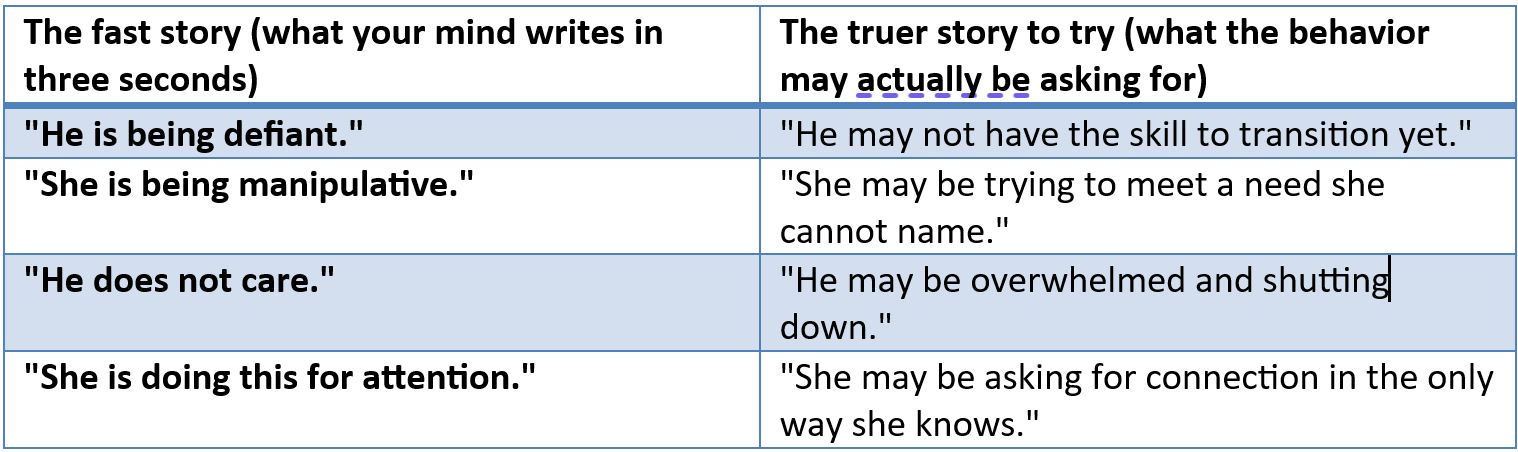
The same mechanism runs through a more recent study by Jenna Russo and Arazais Oliveros, published in 2024 in the Journal of Applied Developmental Psychology. They found that when educators were trained to reattribute a child’s behavior, reframing it from intentional defiance to a developmental or skill-based need, their responses shifted from punitive to supportive. The educators did not acquire new discipline tools. They acquired a new story about what the behavior meant, and that new story changed what they did next (Russo & Oliveros, 2024). The behavior was the same. The belief was different. The outcome followed the belief.
This is the Belief link. Not a philosophy or a posture, but a mechanism. The interpretation you form in the gap between seeing and responding determines what you build, and what you build determines what the child learns. If your staff read behavior as defiance, they build corrections. If they read it as a missing skill, they build relationships that teach the skill. The Belief-to-Outcomes framework starts here because everything else, the nervous system regulation, the executive function support, the systems and the outcomes, only becomes visible once you can see the story you told in the first three seconds.

A REFRAME TOOL FOR THE WEEK
The Fast Story and the Truer Story to Try
Source and reading
Rosenthal, R., & Jacobson, L. (1968). Pygmalion in the classroom: Teacher expectation and pupils’ intellectual development. Holt, Rinehart and Winston.
Raudenbush, S. W. (1984). Magnitude of teacher expectancy effects on pupil IQ as a function of the credibility of expectancy induction: A synthesis of findings from 18 experiments. Journal of Educational Psychology, 76(1), 85-97.
Russo, J. E., & Oliveros, A. D. (2024). Rethinking child behavior: Attribution retraining improves child educators’ understanding and response. Journal of Applied Developmental Psychology, 93, Article 101671. https://doi.org/10.1016/j.appdev.2024.101671

One Small Step this Week
At your next staff meeting, ask each person to recall the last time a child’s behavior surprised them and write down the first thought that came to mind. Then ask them to write one alternative: what skill the child might have been asking to learn. Do not ask anyone to share. Collect the papers. You now have a baseline of the stories your program tells in three seconds, and you have given your staff their first experience of catching the fast story before it runs them.
SECTION 6 · PARTNER HIGHLIGHT
We Cannot Do This Work Alone
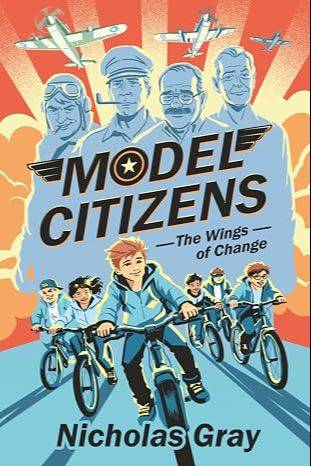
MODEL CITIZENS: THE WINGS OF CHANGE
What happens when five young friends discover that some of their greatest adventures — and greatest teachers — have been hiding right in their own town?
Model Citizens: The Wings of Change is a fast-moving adventure about friendship, imagination, courage and learning to work together.
When a group of young friends discovers a hidden workshop and airplane hangar, they meet an extraordinary group of older veterans, pilots and mechanics. Soon, the kids are learning to build and fly model WWII aircraft, while learning lessons they never expected about trust, responsibility, leadership, respect, belonging and what it means to be part of a team.
As the adventure grows and their town faces a dangerous threat, the young characters discover that everyone brings something different to the team, and that solving a big problem sometimes means listening to people whose experiences are very different from your own.
Filled with action, humor, memorable characters and unexpected twists, Model Citizens gives young readers plenty to think and talk about long after the adventure ends.
ABOUT THE AUTHOR
Nicholas Gray is a lifelong storyteller, musician and songwriter who believes imagination can take you places you never expected to go.
Growing up, Nick struggled in school with what he later discovered was undiagnosed dyslexia. Reading and writing were difficult, but storytelling came naturally. He learned to create stories in his mind, imagine characters and adventures, and find his own way of expressing ideas.
Years later, when he saw some of those same struggles in his own children, he brought them into his imaginative world. The earliest version of Model Citizens began more than 25 years ago as a story Nick developed with his son. Over the years, the story — and the family — grew and changed.
Today, Nick is a published storyteller whose experience reminds young readers that struggling to read or write or express yourself doesn't mean that your contribution isn’t important. Sometimes you just have to find YOUR way you learn, create and tell your story.
The book is available on Amazon and is also available through Ingram, making it accessible to schools, libraries, and bookstores that use Ingram for book distribution. Follow the link below to learn more and purchase the book: https://a.co/d/0gD1DcL6
Additional info….
Modeling after your book club outline and questions you sent, I thought this additional content might be useful as it’s more specifically tied to Model Citizens, and I hope reflects critical-thinking type of questions it looks like you lean into
AFTER YOU READ — TALK ABOUT IT
- Which character did you relate to most, and why?
- What did the younger and older characters learn from each other?
- When did someone have to show courage even though they were unsure or afraid?
- What made the group work as a team?
- If you could join The Model Citizens for one adventure, what role would you want to play?
- If you could change or continue the ending, what would happen next?
JOIN ME IN CELEBRATING MY MILESTONE
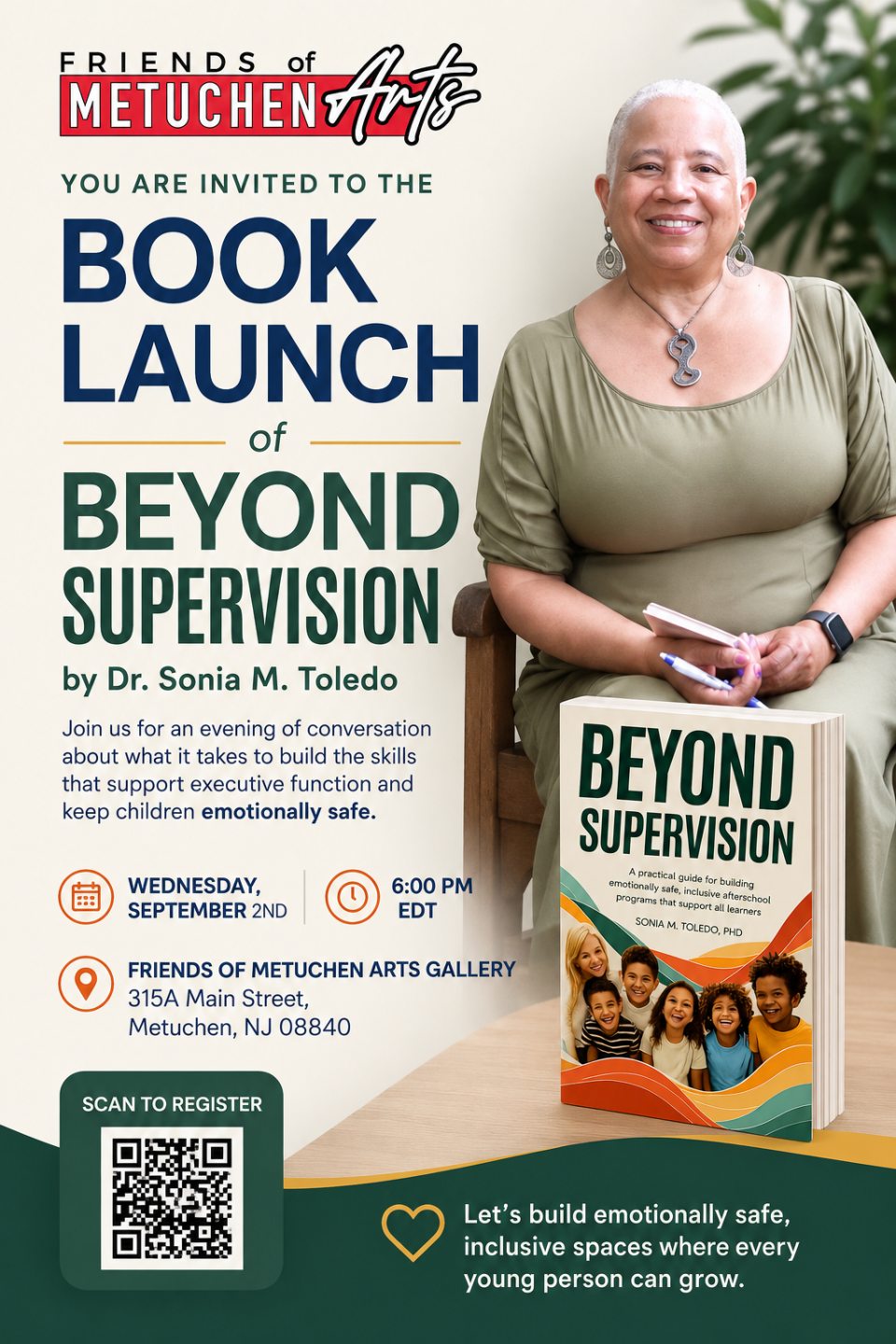
Beyond Supervision walks through all five links of the From Belief to Outcomes framework: Belief, Nervous System, Executive Function, Systems, and Outcomes. Buy the book here. If it has helped your practice, leave a review here.
A Question to Carry into the Week
What did the story you told in the first three seconds cost the child?
With dignity and purpose,
Dr. Toledo
Sonia Toledo, PhD · Founder and CEO, Dignity of Children · Author, Beyond Supervision
P.S.
If this issue spoke to the work you are doing, join our Safe To Thrive Community: https://bit.ly/4g2tM4y
If you know one colleague or leader who needs this, forward this issue to them. They can sign up for The Weekly Practice https://www.dignityofchildren.com/
Next Week
Next week we move to the Nervous System link of the Belief-to-Outcomes framework: What do I do in those three seconds, in my own body first, before I address anyone else’s?



Join the Safe to Thrive movement HERE
Get your Copy Beyond Supervision
Enroll to Lead with Heart & Mind: 6-Week Guided Transformational Journey HERE
Book Professional Development Workshops for Educators HERE
Book Professional Development Workshops for Leadership HERE
Register for Director's Lab 2.0 - a program for Supervisors and Directors
To discuss your training needs, schedule a one-on-one consultation with me HERE
Dignity of Children
The Weekly Practice · Building quality through discipline, adjustment, and consistency.