
DIGNITY OF CHILDREN · DR. TOLEDO
The Weekly Practice
Issue No. 14 Week of September 24th, 2026 Focus: Overview of the Belief-to-Outcomes Framework
A Message to the Program Director
Five weeks ago, you started a practice. You began by noticing the story your mind writes in three seconds, then by settling your own body before responding, then by reading what was under a child’s behavior, then by building a routine that teaches the skill you found, then by looking at what that routine produced. You have walked the full Belief-to-Outcomes framework once, and you have done it while running a program that does not slow down for frameworks. That you made time for each link, in a week that offered none, is the practice itself.
The framework is not a curriculum you implement once and shelve. It is a cycle you run, and each pass through it teaches you something the last pass did not. Your influence on the culture of your program is more dependable than any policy you could write, because culture is built on what you do, not what you mandate. This is why your emotional intelligence is program infrastructure, not a finish line. Your program is not the same one it was five weeks ago, because you are not the same director, and a director who has walked the full framework once has a map they can read again.
Your emotional intelligence focus this week: self-awareness. Look back at the five links and name the one where you felt most confident and the one where you felt most resistance. You are not grading yourself. You are finding the place where the next cycle begins, because the framework starts again at Belief, and it starts sharper when you know where you tend to drift.
THIS WEEK'S FOCUS:
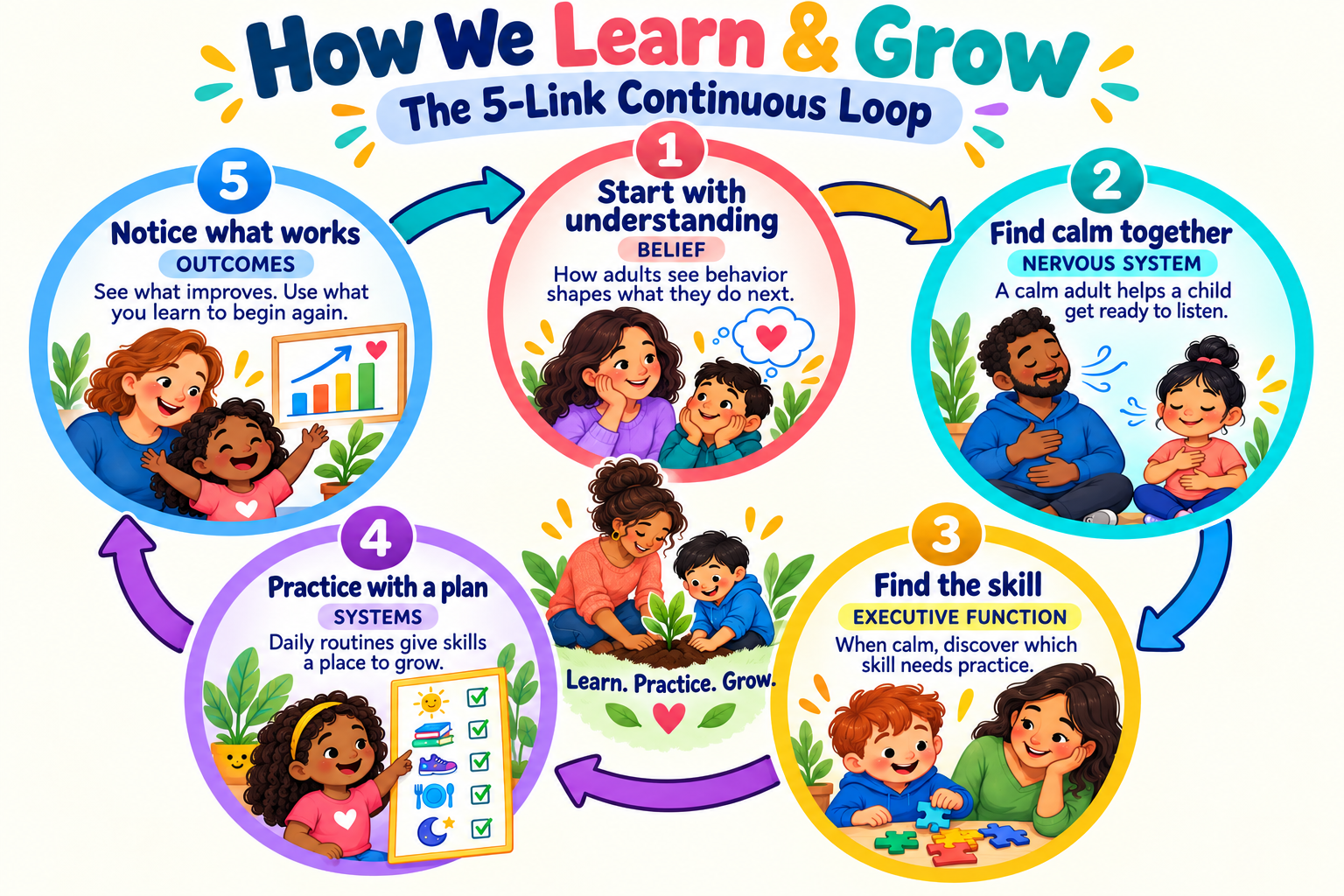
The Belief-to-Outcomes Framework
What has the first pass through all five links taught you, and where do you adjust before the cycle begins again?
The Belief-to-Outcomes framework is five links, one cycle, and it works because the order does not change. Belief comes first because the story you tell about a child’s behavior decides what you build next. Nervous System comes second because the child’s body reads yours before it hears your words, and a dysregulated adult cannot co-regulate a dysregulated child. Executive Function comes third because once the body is settled, you can see which specific skill is missing under the behavior. Systems comes fourth because a skill does not grow from a single response; it grows from a routine that gives the child a place to practice. Outcomes comes fifth because the only way to know whether the system is working is to read what it produces and feed it back into the next cycle.
This is not five separate ideas. It is one process, and the evidence for the whole process is broader than any single link. Joseph Durlak and his colleagues synthesized 213 school-based social and emotional learning programs serving over 270,000 students and found significant improvements across four outcomes: social and emotional skills, attitudes toward self and others, positive social behavior, and academic performance, with an 11-percentile-point gain in achievement (Durlak, Weissberg, Dymnicki, Taylor, & Schellinger, 2011). The programs that worked shared four features: they were sequenced, active, focused, and explicit. They did not teach skills in isolation. They built a system that taught the skill, reinforced it, and measured whether it took. That is the Belief-to-Outcomes framework in empirical form.
The evidence that the adult’s competence is the thread running through all five links is equally clear. Yu Xu and colleagues conducted a three-level meta-analysis of 51 studies with over 19,000 participants, synthesizing the associations between educators’ social-emotional competence and a wide range of outcomes (Xu, Wang, Chen, Sun, & Li, 2024). They found that educators’ social-emotional competence was directly associated with their own well-being, the quality of their relationships with students, the effectiveness of their classroom management, the success of their SEL implementation, and favorable organizational outcomes. The adult’s competence touched every level of the system. The framework you have been walking for five weeks is not a sequence of separate practices. It is one practice, and it begins with you.
The cycle does not end. It begins again at Belief, informed by what the first pass taught you. The second pass is not a repeat. It is a refinement, because you now know where you tend to drift, which link you skip when the week gets tight, and which one you lean into naturally. The framework gives you the structure. Your experience gives you the data. The next cycle uses both.

The Framework Review: Where Will You Adjust?
Take ten minutes with these five questions before the next cycle begins. Do not overthink them. Write one sentence per link.
- Belief: What is one story you have caught yourself telling about a child that you would not have noticed five weeks ago?
- Nervous System: What is one situation where you now pause before responding where you used to react?
- Executive Function: What is one behavior you now read as a skill deficit instead of a discipline problem?
- Systems: What is one routine you built that is still running, and what is it producing?
- Outcomes: What is one thing you are now measuring that you were not measuring before?
Read what you wrote. One of these answers will be thinner than the others. That is where the next cycle begins.
Source and reading
Durlak, J. A., Weissberg, R. P., Dymnicki, A. B., Taylor, R. D., & Schellinger, K. B. (2011). The impact of enhancing students’ social and emotional learning: A meta-analysis of school-based universal interventions. Child Development, 82(1), 405-432. https://doi.org/10.1111/j.1467-8624.2010.01564.x
Xu, Y., Wang, I. Y., Chen, J., Sun, J., & Li, J. (2024). The associations between early childhood educators’ social-emotional competence and a wide range of outcomes: A three-level meta-analysis. Learning and Individual Differences, 114, Article 102521. https://doi.org/10.1016/j.lindif.2024.102521

One Small Step this Week
At your next staff meeting, ask each person to name one link of the framework they practiced this cycle and one where they want to grow. Write the answers on a single sheet. You are not creating a training plan. You are giving your team the same map you have been using, and you are showing them that the framework is not yours alone.

SECTION 6 · PARTNER HIGHLIGHT
We Cannot Do This Work Alone
None of us builds a strong program in isolation. The leaders who go the furthest are the ones who surround themselves with partners, resources, and people who strengthen the work. Each week we will introduce a new partner you can add to your own resources, so that over time you build a network you can lean on instead of carrying everything yourself.
This week's partner is Two by Two Character Development.
Two by Two Character Development is a nonprofit organization that equips schools and youth-serving organizations with engaging, hands-on character education and social-emotional learning experiences. Through rescue-inspired stuffed cats and dogs, interactive lessons, and professional learning, Two by Two helps children build empathy, responsibility, kindness, and the relationship skills they need to thrive.
Core Focus Areas
- Building empathy, kindness, and compassion
- Strengthening social-emotional and character development
- Developing responsibility and positive decision-making
- Creating caring, connected school and youth communities
Signature Programs
- Kindhearted Kids® – Rescue-inspired stuffed cats and dogs that help children practice empathy, responsibility, and life skills through memorable, hands-on experiences.
- Kindhearted Kids® – Meet the Challenge – A collaborative, station-based character education experience where students work together to solve challenges while building teamwork, empathy, perseverance, responsibility, and problem-solving skills.
- Character Connections® – Flexible classroom and small-group resources that reinforce character, social-emotional learning, and relationship-building throughout the school year.
- Professional Learning – Interactive workshops that provide educators and youth professionals with practical strategies to strengthen school culture, student engagement, and belonging.
Impact
- More than 20 years of empowering children through character education.
- Partnering with schools, afterschool programs, counselors, and youth organizations across 40+ states.
- Research-informed programs designed to help children develop the skills they need for success in school, relationships, and life.
Discover educational materials via the official Two by Two Store
Read the full Belief-to-Outcomes framework in Beyond Supervision by Sonia Toledo, PhD.
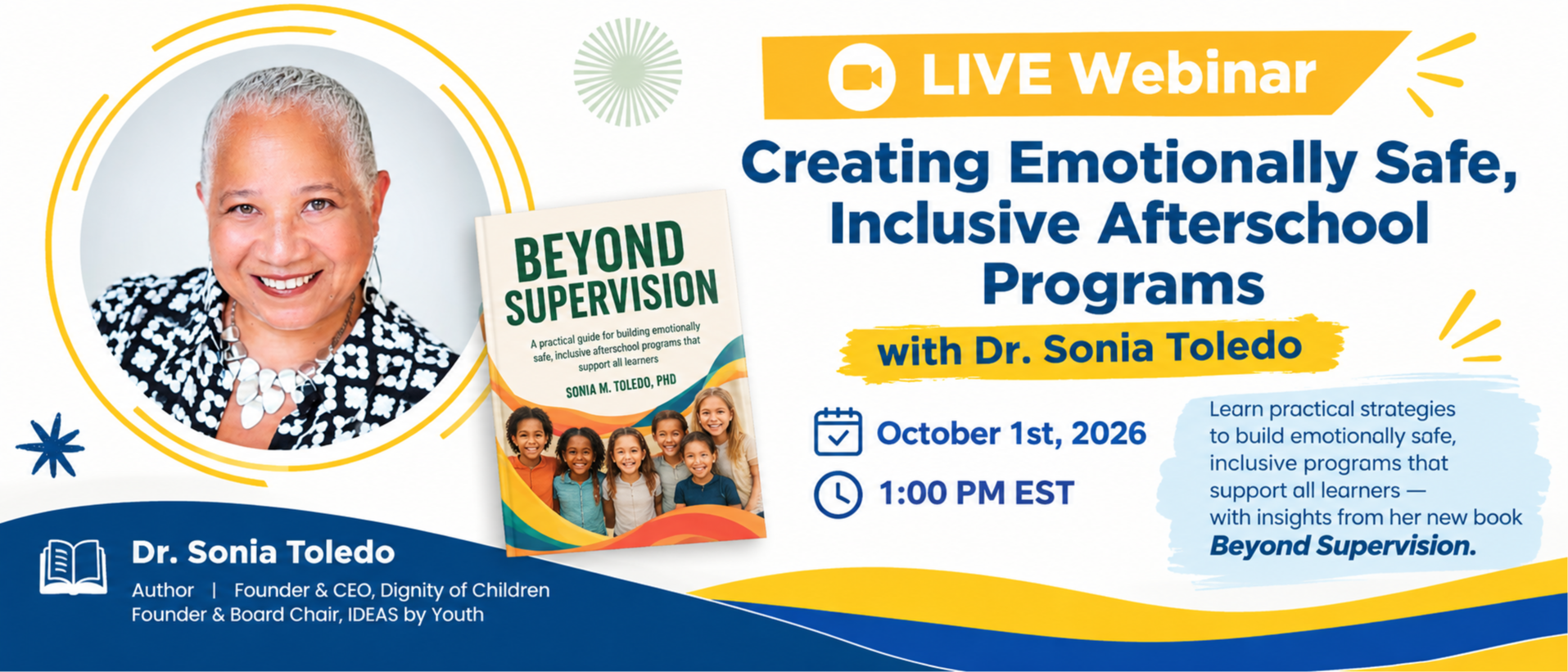
Dr. Sonia Toledo introduces the core ideas behind her new book, Beyond Supervision: A Practical Guide for Building Emotionally Safe, Inclusive Afterschool Programs That Support All Learners. Drawing on her doctoral research in Global Training and Development and years of frontline experience building youth programs across the country, Dr. Toledo will unpack why emotional intelligence in the adults who lead these spaces is the real foundation of safety and inclusion, not just rules and routines.
Participants will walk away with practical strategies for:
• Building a program culture rooted in emotional safety, not just physical safety
• Recognizing how adult self-regulation directly shapes how supported youth feel
• Creating inclusive environments that meet the needs of all learners, including those who are neurodivergent or navigating trauma
• Practical, everyday tools staff can use immediately, no extra budget or training hours required
Whether you lead a single afterschool site or oversee a network of programs, this session will give you a clear, actionable framework to move your team beyond supervision toward truly supportive care.
Bio:
Dr. Sonia Toledo is the Founder & CEO of Dignity of Children and Founder & Board Chair of IDEAS by Youth (IBY). She holds a PhD in Education with a focus on Global Training and Development, and her work spans youth-serving organizations across the United States. A recognized emotional intelligence expert, Dr. Toledo's core philosophy is that adults must first develop their own emotional intelligence before they can truly support young people. She is the author of Beyond Supervision: A Practical Guide for Building Emotionally Safe, Inclusive Afterschool Programs That Support All Learners, available now on Amazon (Amazon.com: Beyond Supervision: A Practical Guide for After-School Leaders to Create Emotionally Saf…). Dr. Toledo speaks and trains nationally on emotional intelligence, inclusive program design, and building resilient, high-functioning youth development teams.
Book: Beyond Supervision: A Practical Guide for Building Emotionally Safe, Inclusive Afterschool Programs That Support All Learners
Available on Amazon: Amazon.com: Beyond Supervision: A Practical Guide for After-School Leaders to Create Emotionally Saf…
A Question to Carry into the Week
Which link of the framework changed the way you see your work?
With dignity and purpose,
Dr. Toledo
Sonia Toledo, PhD · Founder and CEO, Dignity of Children · Author, Beyond Supervision
P.S.
If this issue spoke to the work you are doing, join our Safe To Thrive Community: https://bit.ly/4g2tM4y
If you know one colleague or leader who needs this, forward this issue to them. They can sign up for The Weekly Practice here.
Next Week
Next week the cycle begins again at the Belief link of the Belief-to-Outcomes framework, refined by what this first pass has taught you: What story do I tell in the first three seconds, and how has five weeks of practice changed the stories I tell?


Join the Safe to Thrive movement HERE
Get your Copy Beyond Supervision
Enroll to Lead with Heart & Mind: 6-Week Guided Transformational Journey HERE
Book Professional Development Workshops for Educators HERE
Book Professional Development Workshops for Leadership HERE
Register for Director's Lab 2.0 - a program for Supervisors and Directors
To discuss your training needs, schedule a one-on-one consultation with me HERE
Dignity of Children
The Weekly Practice · Building quality through discipline, adjustment, and consistency.