
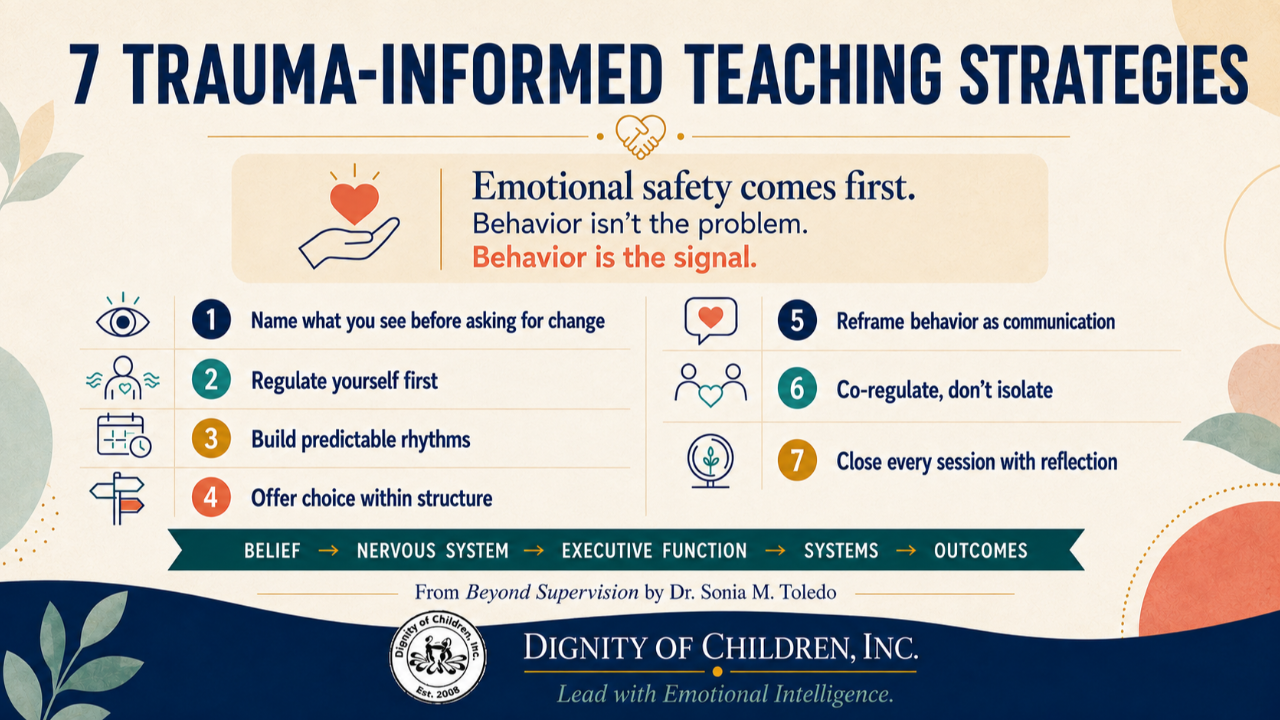
If you've ever walked into a room of young people and felt the energy shift the moment a difficult transition begins, you already understand something most leadership manuals skip: behavior is not the problem. Behavior is the signal.
Trauma-informed teaching strategies start from that premise. They don't ask "how do I get this child to comply?" They ask "what does this child's nervous system need right now to feel safe enough to learn?"
In my book Beyond Supervision, I lay out the Belief-to-Outcome framework — Belief → Nervous System → Executive Function → Systems → Outcomes. Trauma-informed practice lives in the first two steps. When we get those right, the rest follows.
Here are seven strategies you can use this week.
1. Name what you see before you ask for change
Before redirecting a young person, describe what you observe without judgment: "I notice you've been quiet since the group came inside. I'm here when you're ready." This tiny act tells a trauma-affected nervous system, you are seen, and you are not in trouble.
2. Regulate yourself first
A dysregulated adult cannot regulate a dysregulated child. Before you intervene, take three slow breaths. Your calm is contagious — and so is your reactivity. This is the heart of the Nervous System step in the framework: adult regulation comes before child regulation.
3. Build predictable rhythms, not just schedules
Neurodivergent learners and trauma-affected youth thrive on rhythm. Post the day's flow visually, narrate transitions two minutes before they happen, and keep the same greeting every single time. Predictability is a form of safety.
4. Offer choice within structure
"You can do this activity at the table or on the rug — your choice." Choice restores agency, which trauma strips away. Within a clear structure, choice becomes regulation.
5. Reframe behavior as communication
When a young person shuts down, melts down, or pushes back, ask: what need is this behavior communicating? Safety? Sensory regulation? Connection? Behavior support strategies work best when we read the need underneath.
6. Co-regulate, don't isolate
Time-outs isolate. Co-regulation heals. Sit beside the young person, match their breathing, and wait. You don't need words. Your presence teaches their nervous system that big feelings can be survived.
7. Close every session with reflection
Two minutes of reflection at the end of each session builds executive function — the brain's ability to pause, plan, and choose. Ask: "What helped you feel safe today? What was hard?" Over time, this builds the self-awareness that prevents the next escalation.
Where this comes from
These strategies aren't techniques you perform. They're the natural expression of a belief — that every child deserves emotional safety before they're asked to perform academically. That belief becomes a regulated nervous system, which becomes executive function, which becomes the systems and outcomes we all want.
In Beyond Supervision, I walk through how leaders build this chain into the culture of an entire program — not just one classroom. Because the question is never just "how do I handle this moment?" It's "what kind of environment am I building, moment by moment?"
Start here
Pick one strategy from this list. Try it for two weeks. Notice what shifts — in your young people, and in yourself.
If you want to go deeper, join the Safe to Thrive community, where we're building this work together.


