
If you've ever sat through a staff training that felt inspiring in the moment and changed nothing by the following week, you already know the problem with most after-school program training: it treats staff as containers to be filled, not as people to be grown.
Training that fills containers gives you a binder. Training that grows people gives you a team that can regulate, respond, and lead — especially in the hard moments.
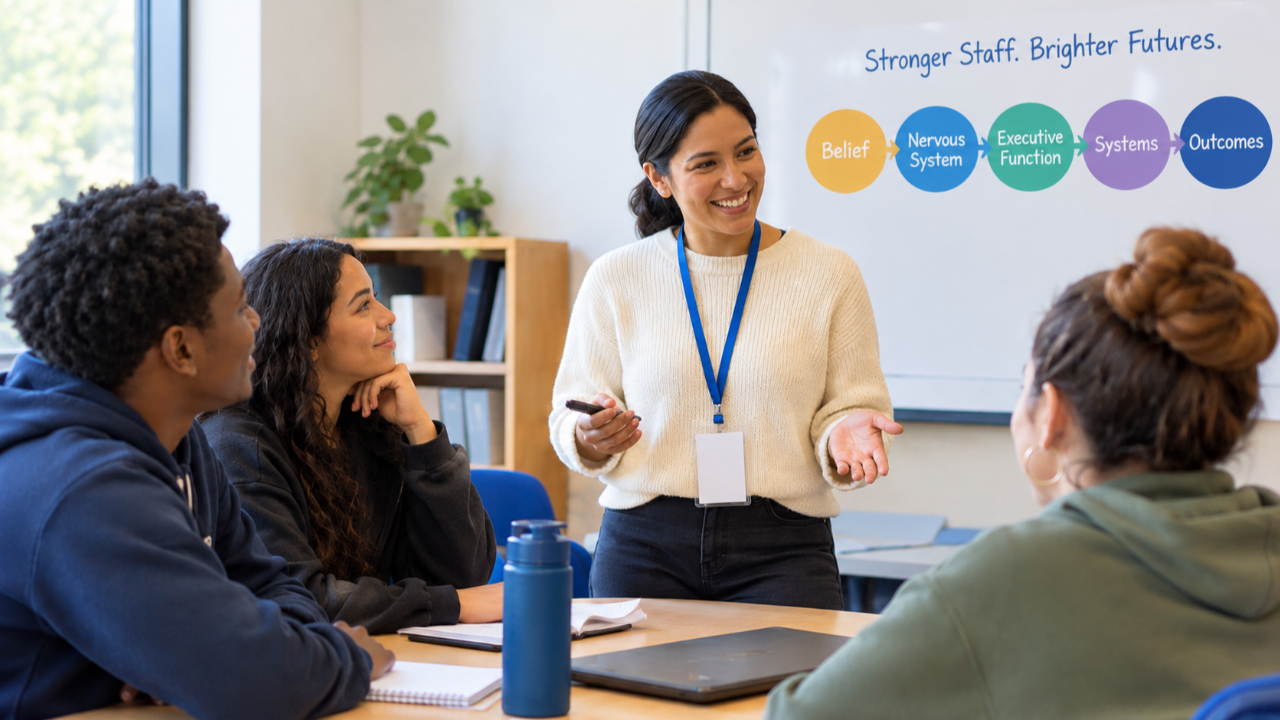
In Beyond Supervision, I introduce the Belief-to-Outcome framework: Belief → Nervous System → Executive Function → Systems → Outcomes. After-school program training touches every link in this chain. When training skips the first two, it fills containers. When it builds the whole chain, it grows people.
Here's what changes the game.
Start with What Staff Believe
Before introducing strategies, ask staff what they believe. About young people. About behavior. About their own role.
Every strategy a staff member learns gets filtered through their beliefs. Two staff members can learn the same de-escalation technique and use it completely differently — one as a way to build connection, the other as a way to maintain control. Belief is the operating system. Training the operating system comes first.
In the Belief-to-Outcome framework, this is the first link. Open your next training with a question, not a slide deck:
“What do you believe about why young people behave the way they do?”
Train the Nervous System, Not Just the Techniques
The second link is the Nervous System, and it applies directly to staff training. A dysregulated staff member will struggle to help a child regulate. Training that ignores staff regulation is training that may never translate into practice.
Effective after-school program training includes:
-
Staff regulation as a professional skill, not a break-room luxury.
-
Co-regulation practice through role-play and real-life scenarios, not theory alone.
-
Honest conversations about burnout, vicarious trauma, and the emotional demands of this work.
A regulated staff team doesn't just learn better. It becomes the environment young people need to feel safe, connected, and ready to learn.
Build Executive Function in Your Staff
The third link is Executive Function. The best after-school program training doesn't just teach staff what to do. It strengthens their ability to read a room, adjust in real time, and reflect on what worked.
That means incorporating:
-
Scenario practice: Give staff opportunities to respond to realistic situations rather than relying on lectures alone.
-
Reflection protocols: Ask questions such as, “What did you notice?” and “What would you try next time?”
-
Peer observation and feedback: Create opportunities for staff members to learn from and support one another.
When staff strengthen their executive function, they stop relying exclusively on scripts and start responding to the young people in front of them. That's the difference between a trained staff member and a growing professional.
Make Training a System, Not an Event
The fourth link is Systems. A one-day training that's never revisited can become a distant memory by Friday. Training embedded in organizational systems — onboarding, weekly team meetings, observation cycles, and peer coaching — has a much better chance of surviving the season and staff turnover.
The question isn't simply, “What did the training cover?”
It's “What does a new staff member learn in their first 90 days? Who teaches them? And how is that learning reinforced?”
When training becomes part of the system, it becomes part of the culture. When it exists only as an event, it risks becoming a binder on a shelf.
The Outcome You're Really After
The fifth link is Outcomes. Attendance sheets and completion records matter, but they are not the ultimate measure of successful training.
The real outcome is a staff team that can:
-
Regulate themselves before helping young people regulate.
-
Respond to behavior as communication rather than automatically interpreting it as defiance.
-
Strengthen their own practice through reflection and peer feedback.
-
Build the same capacities in the young people they serve.
That's the complete chain: belief that staff can grow, a regulated nervous system that supports learning, executive function developed through practice, systems that sustain growth, and outcomes that last.
What to Do This Month
You don't need to redesign your entire professional development program overnight. Start with three practical steps.
-
Open your next training with belief. Ask staff what they believe about the young people they serve. Listen before you teach, and use their responses to guide the conversation.
-
Make regulation part of the training. Incorporate breaks, breathing exercises, and movement. If your staff are exhausted, your training may be landing on empty.
-
Choose one system to strengthen. Introduce a 15-minute weekly reflection, a 90-day observation cycle, or a peer coaching partnership. Start small, make it consistent, and build intentionally.
After-school program training isn't just an event you schedule. It's a culture you build. And that culture grows the same way young people do: one belief, one regulated moment, and one reflection at a time.
Ready to build this into your program? Join the Safe to Thrive community and explore the full Belief-to-Outcome framework in Beyond Supervision by Dr. Sonia Toledo.


