
Social-emotional learning (SEL) is everywhere now — posters, curricula, breathing exercises, feeling charts. And yet, in many programs, the same behaviors keep showing up. The same escalations. The same shutdowns. The same disengagement.
The problem isn't that SEL doesn't work. It's that most SEL curricula skip the first step: the nervous system.
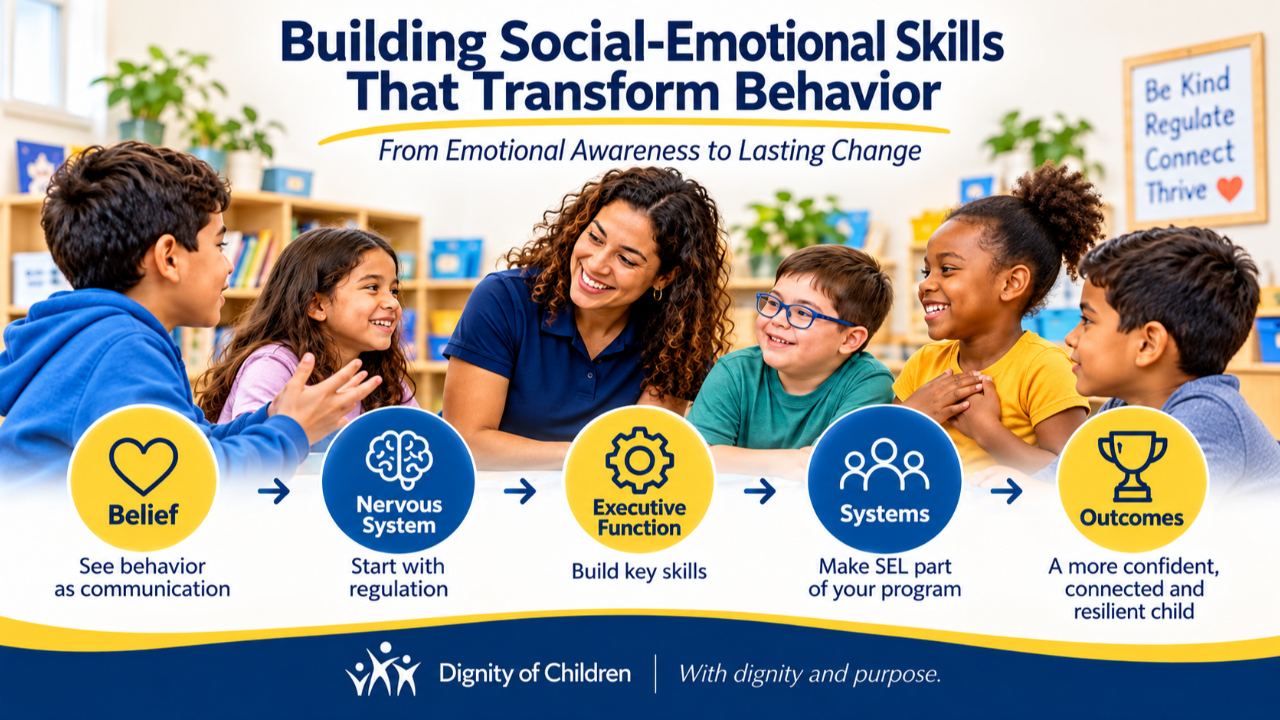
In Beyond Supervision, I lay out the Belief-to-Outcome framework — Belief → Nervous System → Executive Function → Systems → Outcomes. A social-emotional learning curriculum that lives in this framework doesn't just teach feelings vocabulary. It builds the regulation, the executive function, and the systems that actually change behavior.
Here's what a real SEL curriculum looks like — and why most miss the mark.
The Missing First Link: Belief
Before you choose a curriculum, ask what it believes about young people. Does it believe behavior is a skill to be taught — or a problem to be managed? Does it believe young people are capable of self-regulation when given the right conditions — or that they need to be controlled?
Belief isn't a poster. It's the operating system every lesson runs on. A curriculum that believes "behavior is communication" builds different lessons than one that believes "behavior is defiance."
In the framework, this is the first link. Get it wrong, and every later link wobbles.
The Link Most SEL Skips: Nervous System
Here's the hard truth: you cannot teach self-regulation to a young person whose nervous system is in fight-flight-freeze. The prefrontal cortex — where SEL skills live — goes offline under stress.
Yet most SEL curricula hand young people a feeling chart and ask them to "use their words" while they're dysregulated. It's like teaching someone to swim while they're drowning.
A real SEL curriculum starts with regulation before reflection. That means:
-
Co-regulation as the first skill (adult calm first, then child calm).
-
Sensory tools built into the environment, not offered as rewards.
-
Transition routines that protect the nervous system between activities.
This is the Nervous System link of the framework. Without it, SEL is a worksheet.
Build Executive Function, Not Just Feeling Words
The third link is Executive Function. SEL and executive function are often treated as separate topics. They're not. Every SEL skill is an executive function skill in disguise:
-
Self-awareness is self-monitoring, an executive function.
-
Self-management is impulse control and emotional regulation.
-
Responsible decision-making is planning and flexible thinking.
-
Relationship skills require working memory and perspective-taking.
So an SEL curriculum that works builds these skills deliberately — not as vocabulary, but as practiced capacities. That means role-play, real-time reflection, and naming the skill when it shows up in the room.
For neurodivergent young people, this matters enormously. SEL curricula often assume a neurotypical baseline — "use your words," "make eye contact," "wait your turn" — that can actually harm neurodivergent learners. A real SEL curriculum is neurodivergent-affirming: it teaches the skill without pathologizing the different way a young person's brain works.
Make It a System, Not a Lesson
The fourth link is Systems. A 30-minute SEL lesson once a week doesn't change behavior. An entire program culture that teaches SEL in every interaction does.
That means:
-
SEL language in transitions, not just in lesson time.
-
Staff modeling regulation openly ("I need a breath before we continue").
-
Reflection built into the end of every session, not just SEL time.
When SEL lives in the systems, it survives the schedule. When it lives in a lesson, it dies on Friday.
The Outcome You're Really After
The fifth link is Outcomes. Not better feeling-chart scores. The real outcome is a young person who can:
-
Regulate before reacting.
-
Name what they need.
-
Connect with others without losing themselves.
-
Recover from a hard moment without shame.
That's what we're building. That's why the framework is called Belief-to-Outcome.
What to Do This Week
-
Audit your SEL curriculum against the framework. Does it start with belief? Does it regulate the nervous system before teaching skills? Does it build executive function?
-
Pick one system. Build SEL into your transitions or your reflection time — not just your SEL lesson.
-
Check your language. Is your curriculum neurodivergent-affirming, or does it assume one right way to be a young person?
SEL isn't a curriculum you buy. It's a culture you build — one belief, one regulated moment, one reflection at a time.
Ready to build this into your program? Join the Safe to Thrive community and get the full Belief-to-Outcome framework in Beyond Supervision.


